Apr 112013
 

kodikos

12/04 Ημέρα Δράσης για την Ψυχική Υγεία, την Αντιμετώπιση των Εξαρτήσεων και την Πρόληψη

ΜΟΝΟΔΡΟΜΟΣ ΕΙΝΑΙ ΟΙ ΕΝΩΤΙΚΟΙ ΑΓΩΝΕΣ ΜΑΣ ΚΑΙ ΟΧΙ ΤΑ ΜΝΗΜΟΝΙΑ

Είμαστε οι εργαζόμενοι στον ΟΚΑΝΑ, το 18 ΑΝΩ, τα Κέντρα Πρόληψης, το πρόγραμμα Ψυχαργώς.

Είμαστε αυτοί που προσπαθούμε, σε συνθήκες άγριας οικονομικής και κοινωνικής κρίσης, να βοηθήσουμε τους εξαρτημένους στην πορεία προς τη θεραπεία. Αυτοί που προσπαθούμε για την κοινωνική επανένταξη, την υποστήριξη και τη θεραπεία παιδιών και ενηλίκων με ψυχικές διαταραχές, ενάντια στην ασυλοποίηση. Αυτοί που δουλεύουμε καθημερινά ενάντια στην εξάρτηση με γονείς, εκπαιδευτικούς, και νέους.

Είμαστε η φωνή όσων δεν έχουν φωνή, των ευάλωτων ομάδων που η πολιτική της κυβερνητικής τρόικας προορίζει για τον κοινωνικό Καιάδα: Οι περικοπές στους προϋπολογισμούς του ΟΚΑΝΑ, των δομών του Ψυχαρχώς και των Κέντρων Πρόληψης έχουν ως αποτέλεσμα εργαζόμενοι 6, 8 και 11 μήνες απλήρωτοι να κρατούν τις δομές ζωντανές, οι υπηρεσίες μας να υπολειτουργούν και να απειλούνται με κλείσιμο, οι άνθρωποι που εξυπηρετούμε να κινδυνεύουν να βρεθούν στο δρόμο, στο περιθώριο, σε νέα «άσυλα» και «κέντρα κράτησης», με τον κίνδυνο υποτροπής εξυπηρετούμενων στην Ψυχική Υγεία και την Αντιμετώπιση των Εξαρτήσεων να ενισχύεται σημαντικά από αυτή την κατάσταση.

Εργαζόμενοι και σωματεία της Πρόληψης, της Αντιμετώπισης της Εξάρτησης και της Ψυχικής Υγείας έχουμε συναντηθεί εδώ και αρκετούς μήνες, έχουμε κάνει μαζικές διαδηλώσεις και παραστάσεις στο Υπουργείο Υγείας, στο Υπουργείο Οικονομικών, στο Γενικό Λογιστήριο του Κράτους, στη Βουλή, έχουμε απευθυνθεί στην κοινωνία κι έχουμε δεχθεί την αλληλεγγύη συμπολιτών μας κι άλλων εργαζομένων.

Η συνεχιζόμενη εγκληματική πολιτική περικοπών του κοινωνικού κράτους, η αδιαφορία για τους εργαζόμενους που δουλεύουν απλήρωτοι, οι συνεχείς καθυστερήσεις να δοθεί μία οριστική και αξιοπρεπής λύση, οι υποκριτικές μεταθέσεις ευθυνών από Υπουργείο σε Υπουργείο, η υποδοχή μας στο Υπουργείο Υγείας με χημικά και ξύλο δεν μας αφήνουν άλλη επιλογή από το να συνεχίσουμε να αγωνιζόμαστε, να διεκδικούμε και να ασκούμε πιέσεις για όσο χρειαστεί.

Στις 12 Απρίλη συναντιόμαστε πάλι! Απεργούμε, διαδηλώνουμε, διεκδικούμε!

· Αγωνιζόμαστε για την αξιοπρέπεια και το δικαίωμα όσων απευθύνονται στις υπηρεσίες μας να έχουν δημόσια, δωρεάν και ποιοτική φροντίδα.
· Αγωνιζόμαστε για τη δική μας συλλογική, εργασιακή και προσωπική επιβίωση και αξιοπρέπεια.

Την Παρασκευή 12/04:

-Συγκέντρωση στο ΥΥΚΑ στις 10.00πμ για τα σωματεία Απεξάρτησης και Ψυχικής Υγείας
-Συγκέντρωση στο Υπουργείο Εσωτερικών στις 9.30 για το Σωματείο Εργαζομένων στα Κέντρα Πρόληψης
-Συνάντηση όλων των Σωματείων στο Υπουργείο Οικονομικών
-Κοινή πορεία ως τη Βουλή και κατόπιν ως το Υπουργείο Υγείας

Σύλλογος Εργαζόμενων ΟΚΑΝΑ
Σ.Ε.Ψ.Α.Ε.Κ.Ο.
Σωματείο Εργαζόμενων Περιβολάκι
Σωματείο Εργαζόμενων στα Κέντρα Πρόληψης
Σωματείο Εργαζόμενων ¨ΠΥΞΙΔΑ¨ Ηπείρου
Εργαζόμενοι 18ΑΝΩ
Σύλλογος Εργαζόμενων ΚΕΘΕΑ
Σωματείο Εργαζομένων Συλλόγου Ατόμων με Αυτισμό Νομού Λάρισας
Σωματείο Εργαζόμενων στην ΕΔΡΑ

Mar 142013
 

Πηγή: SOS Χαλκιδική

mat_ierissos_1

 Οι επιπτώσεις των αστυνομικών επεμβάσεων στα παιδιά και τους εφήβους

Της Ντίνας Τσελεπή*

Στις 29.1.2013 διοργανώθηκε στην Ιερισσό, με πρωτοβουλία των συλλόγων γονέων και κηδεμόνων, συζήτηση μαθητών του γυμνασίου και του λυκείου με τον Συνήγορο του Παιδιού με θέμα: «Προβληματιζόμαστε και συζητάμε για τα περιβαλλοντικά, οικονομικά και κοινωνικά ζητήματα του τόπου μας».

Οι μαθητές αναφέρουν : «‘Έχουμε ανάγκη να μιλήσουμε στο σχολείο μας για όσα έχουν συμβεί στην περιοχή μας τους τελευταίους μήνες, με αφορμή τις ενέργειες και τις διαδηλώσεις για τα μεταλλεία χρυσού». «Φοβόμαστε για τις εντάσεις που έχουν δημιουργηθεί ή μπορεί να δημιουργηθούν στο μέλλον, όμως δεν επιδιώκουμε την αντιπαλότητα αλλά την προσέγγιση».

Τα επεισόδια που συνέβησαν στις 7 Μαρτίου (ασύστολη αστυνομική βία, χρήση δακρυγόνων, ακόμη και στην αυλή του σχολείου, τηλεφωνικές κλήσεις από την αστυνομία σε ανήλικους προκειμένου να παρουσιαστούν στο αστυνομικό τμήμα) αποτελούν τραυματικά γεγονότα με σοβαρές ψυχολογικές επιπτώσεις στα παιδιά και τους εφήβους της συγκεκριμένης κοινότητας και όχι μόνο.

«Είναι δυνατόν να τρομοκρατούν τα παιδιά; Οι συμμαθητές μας της Α` Γυμνασίου δεν ξέρουν τι είναι τα δακρυγόνα και ξαφνικά βλέπουν ένα σχολείο ανάστατο και αστυνομικούς από έξω. Και μετά λένε ότι τα παιδιά των εργαζομένων της εταιρείας φοβούνται για τη ζωή τους, εμείς τι να πούμε;»

Όσοι από εμάς παρέχουμε συμβουλευτικές υπηρεσίες και στήριξη σε παιδιά και εφήβους που έρχονται αντιμέτωποι με γεγονότα απειλητικά για τη ζωή τους, γνωρίζουμε πολύ καλά ότι βιώνουν έντονο στρες, φόβο, τρόμο και ένα αίσθημα αδυναμίας που τους κατακλύζει και συχνά υπερβαίνει τα διαθέσιμα αποθέματά τους.

Οι συνήθεις αντιδράσεις που εμφανίζονται στα παιδιά και τους εφήβους, όταν εκτίθονται σε τραυματικά γεγονότα, είναι να παρουσιάζουν σοβαρά προβλήματα με τον ύπνο. Βλέπουν εφιάλτες,φοβούνται το σκοτάδι και έχουν έντονη την αίσθηση της ευαλωτότητας. Πολύ συχνά παρουσιάζουν παλινδρόμηση σε προηγούμενα στάδια ανάπτυξης καθώς και αλλαγές στη συμπεριφορά, με επιθετικότητα ή νευρικότητα. Ταλαιπωρούνται από το φόβο επανάληψης των γεγονότων και ανησυχούν ιδιαίτερα για τα οικεία τους πρόσωπα. Υποφέρουν από συχνούς πονοκεφάλους και παρουσιάζουν σημαντικές δυσκολίες στη συγκέντρωση και μνήμη.

Το τραύμα που προκαλείται από ανθρώπινη παρέμβαση, και δεν οφείλεται π.χ. σε μία θεομηνία, επηρεάζει- δηλητηριάζει μία διάσταση που είναι σημαντική για τον άνθρωπο: τη θεμελιώδη εμπιστοσύνη στο είδος, τη βασική εμπιστοσύνη σε άλλους ανθρώπους. Οι συνέπειες των τραυματικών εμπειριών μπορούν να αντιμετωπιστούν καλύτερα, αν μπορούν οι άνθρωποι να προσδώσουν ένα νόημα σε αυτό που τους συνέβη.

Στις περιπτώσεις όμως που ασκείται βία, η νοηματοδότηση γίνεται πιο δύσκολη, ιδιαίτερα για τα παιδιά και τους εφήβους. Οι αρνητικές ψυχοκοινωνικές επιπτώσεις, μετά από καταστροφικά ή τραυματικά γεγονότα, εάν δεν αντιμετωπιστούν κατάλληλα, μπορεί να εξελιχθούν σε μετατραυματική διαταραχή του στρες και να επηρεάσουν την εξέλιξη των παιδιών και εφήβων.

Παρακολουθώντας, λοιπόν, τα γεγονότα όλες αυτές τις ημέρες, μου δημιουργήθηκαν κάποια ερωτήματα:

Ποια μέτρα έλαβε το υπουργείο για να προστατέψει μαθητές και εκπαιδευτικούς από έκθεση σε τραυματικά γεγονότα, όπως αυτά της 7ης Μαρτίου;

Ποια ήταν η παρέμβαση του υπουργού Παιδείας, όταν ενημερώθηκε για την ασύστολη και επικινδυνη χρήση δακρυγόνων στην περιοχή;

Ποιες ήταν οι οδηγίες του υπουργείου Παιδείας, προκειμένου να εφαρμοστεί σχέδιο διαχείρισης της κρίσης στη σχολική κοινότητα; Αλήθεια, υπάρχει σχεδιασμός διαχείρισης της κρίσης στις σχολικές κοινότητες, μετά από ένα τραυματικό ή καταστροφικό γεγονός;

Ποιος είναι ο σχεδιασμός του υπουργείου σε σχέση με την υποστήριξη των μαθητών που έχουν βιώσει τραυματικές εμπειρίες; (Στην περιοχή κατέφθασε ιδιώτης ψυχολόγος, προκειμένου να προσφέρει τις υπηρεσίες του, σύμφωνα με δημοσιογραφικά δημοσιεύματα).

Σύμφωνα με το σχεδιασμό του υπουργείου,στις 6 Μαρτίου καλούνταν όλα τα σχολεία Α’βάθμιας και Β’ Βάθμιας εκπαίδευσης νααφιερώσουν χρόνο σε δράσεις – συζητήσεις–εκδηλώσεις κατά του σχολικού εκφοβισμού, με στόχο την ευαισθητοποίηση των σχολικών κοινοτήτων και την επαγρύπνηση όλων των μελών τους για την έγκαιρη παρέμβαση, ώστε να περιοριστούν οι δίαυλοι εκδήλωσης της βίας στη ζωή των ανηλίκων και να αποτραπούν οι αρνητικές της συνέπειες στις διαπροσωπικές τους σχέσεις.

Πολύ φοβάμαι ότι το υπουργείο Παιδείας στις 7 Μαρτίου δεν είχε κανένα σχεδιασμό και καμία πρόληψη για την προστασία των μαθητών από τη βία και τον εκφοβισμό που υπέστησαν από την αστυνομία. Αντίθετα, επέτρεψε την έκθεση των μαθητών σε τραυματικές εμπειρίες με πιθανές σοβαρές επιπτώσεις στην ψυχική τους υγεία. Η σιωπή του υπουργού είναι συνενοχή. Πρέπει να είναι αίτημα όλης της εκπαιδευτικής κοινότητας να αποδοθούν ευθύνες. Δε μπορούμε να αδιαφορήσουμε.

* Η Ντίνα Τσελεπή είναι ψυχολόγος-συστημική θεραπεύτρια, εργαζόμενη στο Α’ ΚΑΔΔΕ Θεσσαλονίκης

Mar 012013
 

Πηγή: iatropedia.gr

Δραματική έκκληση ψυχιάτρων: Μην απολύετε εργαζόμενους- Θα αυξηθούν οι αυτοκτονίες!

Νέα δεδομένα στην ψυχή των χιλιάδων Ελλήνων φέρνει το μνημόνιο αλλά πρωτίστως αυξάνει την αγωνία για την πιθανότητα της ανεργίας. Τι έκκληση κάνουν Έλληνες ειδικοί.

Μην απολύετε εργαζόμενους για να μην έχουμε αύξηση των αυτοκτονιών, διαμηνύουν Έλληνες ειδικοί σε μια περίοδο κρίσης όπου οι αυτόχειρες αλλά και όσοι έχουν κατάθλιψη αυξάνονται μέρα με την ημέρα από τα δυσβάσταχτα οικονομικά προβλήματα.

Έλληνες ψυχίατροι τη μείωση των μισθών και όχι την απόλυση των εργαζομένων ώστε να καμφθεί και το κύμα της εθνικής μας θλίψης και να μειωθεί ο κίνδυνος των αυτοκτονιών.

Με αφορμή το διεθνές συνέδριο με θέμα “Κρίσεις και Καταστροφές. Ψυχοκοινωνικές Επιπτώσεις”, το οποίο διοργανώνουν η Ελληνική Ψυχιατρική Εταιρεία και η Παγκόσμια Ομοσπονδία Ψυχικής Υγείας, με τη συνεργασία της Εταιρείας Προληπτικής Ψυχιατρικής, ο καθηγητής Ψυχιατρικής Γιώργος Χριστοδούλου, και ο αναπληρωτής καθηγητής Ψυχιατρικής του Πανεπιστημίου Αθηνών Δημήτρης Πλουμπίδης, υποστήριξαν πως η απόλυση από την εργασία, πέρα από τις οικονομικές της επιπτώσεις, συνεπάγεται επίσης ένα ταπεινωτικό πλήγμα για τον εργαζόμενο, το οποίο προκύπτει από την μείωση του οικογενειακού και κοινωνικού του status.

Τα στοιχεία πάντως που δείχνουν τη θλίψη των Ελλήνων εν μέσω κρίσης είναι τραγικά. Σύμφωνα με τα μέλη της Ελληνικής Ψυχιατρικής Εταιρείας, το τελευταίο διάστημα παρατηρείται στα ιατρεία και τις κλινικές τους μια κατακόρυφη αύξηση των ανθρώπων που ζητούν βοήθεια. Η αναμονή μάλιστα για ραντεβού για τα μη επείγοντα περιστατικά, έχει εκτοξευθεί στους δυόμιση μήνες από 15 ημέρες που ήταν το 2009.

Οι ειδικοί παρατηρούν ότι πλέον τα περιστατικά αφορούν άτομα κυρίως από 25 έως 50 ετών, οι περισσότεροι από τους οποίους αναμένεται να απολέσουν την ασφαλιστική τους κάλυψη το επόμενο διάστημα.

Feb 052013
 

Πηγή: tvxs.gr

Άνθρωποι που δίνουν εντολές, που βιαιοπραγούν ή που απλά παρακολουθούν -ως συνένοχοι- βασανισμό κρατουμένων, είναι ψυχοπαθητικές προσωπικότητες που χρήζουν μακράς ψυχολογικής υποστήριξης. Αυτό είναι κάτι που θα πρέπει πρώτα απ’ όλα να το αναγνωρίσουμε, και όχι να τους προστατεύουμε με το να κωφεύουμε… Η Ελένη Νίνα, κλινικός ψυχολόγος και ψυχοθεραπεύτρια, μιλά με την δημοσιογράφο και σύμβουλο ψυχικής υγείας Κρυσταλία Πατούλη για το tvxs.gr, θέτοντας το ζήτημα των παράνομων διώξεων, των βασανισμών, της καταπάτησης των ανθρωπίνων δικαιωμάτων, όπως και κάθε βίας – κακοποίησης, στον πυρήνα της φασιστικοποίησης της κοινωνίας μας.

Ελ.Ν.: Πιθανώς, η συγκεκριμένη περίπτωση, ήταν μια ατυχής παραποίηση. Προσπάθησαν να παραποιήσουν και να καλύψουν το έγκλημά τους αλλά συγχρόνως και να το δείξουν.

Κρ.Π.: Μήπως να το επιδείξουν;

Ελ.Ν.: Είναι το θράσος. Υπάρχει ένα θράσος μέσα σε μία ανάλογη πράξη, όπως και μια επίδειξη ισχύος:

«Καλύπτω αυτό που έχω κάνει, αλλά όχι τόσο ώστε να μη το δεις. Πρέπει και να το δεις. Πρέπει να καταλάβεις ότι εγώ είμαι ο ισχυρός. Και έχω την ισχύ, και να σου κάνω κακό, και να το καλύψω, και να το αφήσω να φανεί. Άρα, εγώ έχω τον έλεγχο».

Είναι μία επίδειξη ισχύος και ελέγχου.

Κρ.Π.: Όχι μόνο στους δράστες, αλλά και στους απλούς πολίτες, ώστε π.χ. να σοκαριστούν και να φοβηθούν;

Ελ.Ν.: Βεβαίως, είναι σοκαριστικό, γιατί η πράξη μπορεί να είναι αξιόποινη, αλλά ο οποιοσδήποτε έχει το δικαίωμα μιας έντιμης δίκης.  Αυτό, λοιπόν, το δικαίωμα, καταστρατηγείται σταθερά, γενικά από την ανθρωπότητα.  Δεν είναι η πρώτη φορά. Είναι… άλλη μια φορά, που καταστρατηγούνται τα ανθρώπινα δικαιώματα και το δικαίωμα του καθενός να δικαστεί και να καταδικαστεί, ή οτιδήποτε, για την πράξη που έχει κάνει.  Λοιπόν, η βία, έχει γεννηθεί με τον άνθρωπο. Αυτό είναι το σοκαριστικό. Το πόσο ο άνθρωπος ορμάει στον άλλον άνθρωπο για να τον ελέγξει και να τον νικήσει κατά κράτος.

Σε μια παλιότερη συνέντευξη που σου έχω δώσει, το έχω τονίσει αυτό: Ότι, δεν αρκεί να νικηθεί ο αντίπαλος. Πρέπει να καταστραφεί! Αυτό είναι που ξεχωρίζει τον άνθρωπο, ως πολύ άγριο θηρίο. Αντίθετα στα θηλαστικά, που ζουν σε αγέλες, ο ισχυρός καλεί σε μάχη τον αντίπαλο, κι αν ο αντίπαλος πέσει και κάνει μια πράξη υποταγής, ο άλλος υποχωρεί και είναι ο νικητής. Η αγέλη τον ανακηρύσσει νικητή. Δεν χρειάζεται να τον καταστρέψει! Αντίθετα, ο άνθρωπος, δεν σταματάει πουθενά!

Κρ.Π.: Ο άνθρωπος γεννά τη βία, αλλά, ο άνθρωπος γεννά και τον πολιτισμό, τη δημοκρατία, τα ανθρώπινα δικαιώματα…

Ελ.Ν.: Και τα καταστρατηγεί επίσης…

Κρ.Π.: Επίσης γεννά τους νόμους, τη δικαιοσύνη, που θέτουν τις βάσεις του τρόπου συνύπαρξης. Όταν το ίδιο το κράτος, δεν λαμβάνει υπόψιν του τους νόμους που το ίδιο έθεσε και υποτίθεται υπηρετεί, και τους καταργεί με ανάλογες επιδείξεις εγκληματικής βίας, τότε, το μόνο που μπορούμε να περιμένουμε είναι η γενίκευση της βίας. Δηλαδή επιστρέφουμε στις σπηλιές… ξανά.

Ελ.Ν.: Ή μπαινοβγαίνουμε στις σπηλιές. Δεν γυρνάμε πίσω. Μπαινοβγαίνουμε.  Ο πολιτισμός, είναι προϊόν των ολίγων. Οι λίγοι παράγουν πολιτισμό. Οι περισσότεροι, παράγουν καταστρατήγηση του πολιτισμού και βία. Οπότε, υπάρχει ένα συνεχές πήγαινε-έλα στις… σπηλιές! Κάποιοι πηγαινοέρχονται, κάποιοι έχουν αποφασίσει να βγουν, και άλλοι μένουν. Πολύς κόσμος, όμως, πηγαινοέρχεται…

Και η βία, είναι αυτό που είδαμε, το οποίο είναι το απόγειο της βίας, αλλά είναι και η κακοποίηση των παιδιών, είναι η κακοποίηση των γυναικών, είναι οι προσβολές, είναι οι ύβρεις, πράξεις πολιτικών, πολιτών…

Κρ.Π.: Και η εξαθλίωση…

Ελ.Ν.: Η εξαθλίωση, και τόσα άλλα. Και αυτή τη στιγμή, το βλέπουμε και ωμά, όπως λες, με αυτό το γεγονός των βασανισμών. Με την κακοποίηση, γίνεται η καταστρατήγηση του φυσικού ορίου που είναι το σώμα μας. Έκει βρίσκεται και η συνειδητοποίηση, ότι είναι ένας Άλλος άνθρωπος.

Κρ.Π.: Δηλαδή;

Ελ.Ν.: Δηλαδή, το σώμα του καθενός για τον οποιονδήποτε, είναι ο Άλλος. Είμαστε άλλοι, διαφορετικοί. Στους βασανισμούς καταργείται αυτό το φυσικό όριο, ότι δηλαδή, έχουμε να κάνουμε με έναν άλλον άνθρωπο που έχει δικαιώματα, που έχει την δική του ύπαρξη, που έχει τη ζωή του. Δεν υπάρχει τίποτα, λοιπόν. Δεν υπάρχει σεβασμός στην ύπαρξη του Άλλου!

Κρ.Π.: Οι άνθρωποι που φτάνουν στο σημείο να μην αναγνωρίζουν την ύπαρξη του Άλλου, ασκώντας οποιαδήποτε μορφή κακοποίησης, δηλαδή βίας, τί άνθρωποι είναι;

Ελ.Ν.: Οι βασανιστές, είναι άνθρωποι, φυσικά, που δεν έχουν κανένα όριο. Μιλάμε για παθολογία. Είναι άνθρωποι ψυχοπαθητικοί, σαδιστές, και δεν έχουν κανέναν ηθικό φραγμό. Ο άνθρωπος ο οποίος χτυπάει, βασανίζει, κακοποιεί, δεν έχει κανένα φραγμό. Και δεν υπάρχει καμία δικαιολογία, καμία βία δεν είναι καλή, ωφέλιμη, χρήσιμη…

Κρ.Π.: Εκτός αν είναι άμυνα…

Ελ.Ν.: Ακριβώς. Επίσης, όταν κάποιος κακοποιεί, π.χ. ένας άντρας μια γυναίκα, ή ένας ενήλικος ένα παιδί, κλπ., ή όταν κακοποιούν συλληφθέντες και φυλακισμένους, ή ανθρώπους στο δρόμο…

Κρ.Π.: … που γενικά, για οποιονδήποτε λόγο, δεν μπορούν να υπερασπίσουν τον εαυτό τους…

Ελ.Ν.: …ακριβώς… σημαίνει, ότι αυτός που κακοποιεί έχει παθολογία. Και έτσι πρέπει να αντιμετωπίζουμε ανάλογες περιπτώσεις ανθρώπων. Σαν ανθρώπους, οι οποίοι πο-τέ δεν είχαν όρια, που σαφέστατα ανήκουν σε κατηγορία ψυχικής διαταραχής, και έτσι πρέπει να αντιμετωπίζονται. Δεν υπάρχει καμία δικαιολογία.

Κρ.Π.: Και οι οποίοι βρίσκονται και σε διάφορες θέσεις, π.χ. στην αστυνομία…

Ελ.Ν.: Στην αστυνομία, και σε θέσεις εξουσίας. Σε μια άλλη περίπτωση θα μπορούσε να είναι ο μπαμπάς ενός παιδιού, ή ο άντρας μιας γυναίκας, ή ένας νέος που χτυπάει έναν γέροντα.

Κρ.Π.: Ο άνθρωπος που δεν έχει όρια, τι σχέση μπορεί να έχει με κάθε μορφή εξουσίας;

Ελ.Ν.: Αμφισβητεί οποιαδήποτε εξουσία. Δεν υπάρχει. Την παίρνει μόνος του. Είναι αυτός η εξουσία. Την ενδύεται και την υποδύεται την εξουσία. Είναι ο ίδιος, η απόλυτη εξουσία, και μάλιστα η αυταρχική εξουσία. Δηλαδή: Θα κάνεις ότι λέω εγώ. Γι’ αυτό και είπα πριν, ότι δεν αναγνωρίζει τον Άλλον ως ύπαρξη. Ο Άλλος είναι το υποχείριό του, είναι κάτι που μπορεί να το κάνει ότι θέλει ο ίδιος. Οπότε, δεν έχει ενδοβάλει κανένα πρότυπο ιεραρχίας, ένας τέτοιος άνθρωπος, ούτε κανένα πρότυπο ύπαρξης του Άλλου. Είναι μόνος του, και ο άλλος είναι εκεί για να εξυπηρετήσει τις διαθέσεις του. Ως εκ τούτου, μπορεί να τον παραβιάσει, να τον βιάσει, να τον κακοποιήσει και να τον σκοτώσει. Γι’ αυτό, μιλάμε για μεγάλη ψυχοπαθολογία.

Κρ.Π.: Δηλαδή χρειάζονται…

Ελ.Ν.: Αυτοί οι άνθρωποι χρήζουν ψυχολογικής βοήθειας, μακρόχρονης βεβαίως, για να γίνει επανεκπαίδευση σε βασικές αρχές, πάνω στο πως μπορεί να ζει ένας άνθρωπος μέσα σε κοινότητα. Διότι έχουν καταστρατηγήσει αυτό ακριβώς: Την συμβίωση, την συνύπαρξη. Δεν υπάρχει εγγεγραμμένη, σ’ αυτούς τους ανθρώπους, η συνύπαρξη…

Κρ.Π.: Εκτός από αυτούς τους ανθρώπους που ασκούν βία και κάθε είδους κακοποίηση(η οποία είναι φασισμός, διότι φασισμός δεν είναι μόνο ο ναζισμός)…

Ελ.Ν.: Βεβαίως…

Κρ.Π.: …οι οποίοι όπως είπες, χρήζουν ψυχολογικής βοηθείας, υπάρχουν και οι άλλοι, που αδιαφορούν(και η αδιαφορία επίσης είναι φασισμός). Αυτοί οι άνθρωποι που αδιαφορούν, δεν χρήζουν βοηθείας, επίσης;

Ελ.Ν.: Η απάθεια, δεν είναι αρετή. Η απάθεια, είναι επίσης διαταραχή. Και αυτό πρέπει να το βάλουμε καλά στο νου μας. Και γι’ αυτό, με ότι μέσα διαθέτει ο καθένας από μας, θα πρέπει να δίνουμε τον αγώνα μας, ενάντια στη βία, απ’ όπου κι αν βρισκόμαστε. Κι αυτό πρέπει να το έχουμε καλά στο νου μας.

Κρ.Π.: Αυτό για να το κάνουμε, πρέπει πρώτα να έχουμε επίγνωση τι σημαίνει βία… Γιατί κάποιοι το αντιλαμβάνονται, μόνον όταν…

Ελ.Ν.: … χτυπήσει την πόρτα τους.

Κρ.Π.: Ούτε και τότε. Εφόσον, αυτή τη στιγμή στην Ελλάδα, παραβιάζεται κατ’ εξακολούθησιν το Σύνταγμα(πράξεις νομοθετικού περιεχομένου, επιβολή επιτάξεων εργαζομένων, στάση εργασίας δημοσίων δικαστικών λειτουργών), διώκονται άνθρωποι που έχουν καταθέσει κοινωνικό έργο για δεκαετίες, όπως η Κατερίνα Μάτσα, η υπεύθυνη του 18Άνω, διώκονται άνθρωποι που υποστηρίζουν τα ανθρώπινα δικαιώματα, και τόσα άλλα… Κι όμως, κάποιοι, μόνον, από την κοινωνία, το αντιλαμβάνονται. Μοιάζει, ο κόσμος –στην καλύτερη περίπτωση- να μην διαθέτει το κριτήριο του τι σημαίνει βία, ή –στην χειρότερη- αδιαφορούν γι αυτό ή πιστεύουν ότι δεν τους αφορά. Τί περιμένουν να δούνε για να το καταλάβουν; Νεκρούς;

Ελ.Ν.: Ακόμη και τότε, θα υπάρξουν άνθρωποι, πάρα πολλοί που θα είναι απαθείς. Συνεργοί! Γιατί με την απάθεια, γίνεσαι συνεργός στο έγκλημα. Και αυτό θα πρέπει να το ακούσουμε όλοι μας. Υπάρχουν οι βίαιοι, αλλά και οι συνεργοί της βίας, όλοι αυτοί, που είναι οι απαθείς!

Ας θυμηθούμε πριν κάποια χρόνια, που μετέδιδε το CNN, σκηνές από τον πόλεμο στο Ιράκ και οι άνθρωποι έπαιρναν τα ποπ κορν και καθόντουσαν και βλέπαν τον πόλεμο στο Ιράκ, σα να ήταν σήριαλ. Εκατομμύρια άνθρωποι, παρακολουθούσαν το σήριαλ… του πολέμου. Πότε ανεβαίνουν οι ακροαματικότητες στις τηλεοράσεις; Όταν υπάρχει αίμα, όταν υπάρχει βία, κι όταν αισθάνονται ασφαλείς οι άλλοι, μέσα στο σπιτάκι τους, γιατί δεν συμβαίνει στους ίδιους, αλλά συμβαίνει σε κάποιους άλλους! Και σχολιάζουνε: Καλώς τους κάνουνε, ή κακώς τους κάνουνε. Αλλά; Δεν κινούνται! Γι αυτό λέω, ότι η απάθεια δεν είναι αρετή. Είναι συνενοχή!

Κρ.Π.: Και στις μέρες μας η απάθεια είναι στο απόγειό της, γιατί ακριβώς μέσω της τηλεόρασης, οι άνθρωποι έχουν γίνει ενεργοί τηλεθεατές, είναι κατά πλειοψηφία αδρανοποιημένοι, δηλαδή, κυρίως ενδιαφέρονται να μάθουν «Τί έγινε;» αλλά δεν αναρωτιούνται, «Τί μπορώ να κάνω εγώ, γι’ αυτό που έγινε, ως πολίτης; Πώς μπορώ να αντιδράσω, να πράξω, να συμμετέχω σ’ αυτό που γίνεται; Ή πώς μπορώ να κάνω εγώ ο ίδιος κάτι να γίνει;». Και τέλος «Τί ευθύνη έχω εγώ, γι αυτό που συμβαίνει;»

Ελ.Ν.: Και υπάρχει όλο και μεγαλύτερη αποδιοργάνωση στον συνδετικό, κοινωνικό ιστό. Οι άνθρωποι απομονώνονται! Γι αυτό και εμείς οι ψυχολόγοι, λέμε (κι όχι μόνον εμείς, και άλλοι) ότι χρειάζεται να γίνει ενίσχυση των κοινωνικών ομάδων: Σε γειτονιές, σε θεραπευτικές ομάδες, σε ομάδες αλληλεγγύης, σε ομάδες κοινωνικής δράσης. Να ενισχυθούν οι κοινωνικοί ιστοί!

Αυτό που συμβαίνει σ’ αυτά τα παιδιά, μπορεί να συμβεί και σε μας! Είναι αξιόποινη πράξη, η πράξη τους, να δικαστούν, αλλά όχι να κακοποιηθούν! Κανείς δεν έχει δικαίωμα να αποδώσει δικαιοσύνη. Υπάρχουν άνθρωποι εξειδικευμένοι στο να αποδώσουν δικαιοσύνη, και κει πρέπει να απευθυνθούμε.

Κρ.Π.: Οι οποίοι (κάποιοι από αυτούς τουλάχιστον), καταστρατηγούν το Σύνταγμα και αυθαιρετούν –και άρα ασκούν βία και κακοποίηση, δηλ. διαπράττουν αξιόποινες πράξεις, και εγκλήματα- από θέση εξουσίας, επίσης…

Ελ.Ν.: Έτσι είναι, αλλά αυτό δεν σημαίνει ότι θα πάρουμε εμείς το δικαίωμα να αποδώσουμε δικαιοσύνη, γιατί τότε καταστρέφεται η συνύπαρξη στις κοινότητες.

Κρ.Π.: Μα, έχει καταστραφεί ήδη, με αυτά που γίνονται…

Ελ.Ν.: Συμφωνώ.

Κρ.Π.: Οι νέοι είναι ο καθρέφτης της κοινωνίας, είναι ο καθρέφτης μας…

Ελ.Ν.: Και ο ένας καταπατά το δικαίωμα του άλλου. Όπως αυτά τα παιδιά πήγαν να κλέψουν… αξιόποινη η πράξη, που σημαίνει ότι εκεί έχει γίνει μια ρωγμή μέσα τους, ως προς την ένταξή τους στο κοινωνικό σύνολο.

Κρ.Π.: Κάποιοι ήταν φίλοι με τον δολοφονημένο Αλέξανδρο Γρηγορόπουλο…

Ελ.Ν.: Οπότε λες, ότι έχουν πολύ θυμό μέσα τους και αδικία, κλπ. Αυτό, όμως δεν είναι μέσον… να κλέψουν για να εκδικηθούν… Η εκδίκηση γεννά βία, η βία γεννά βία, κλπ. Όπως, λοιπόν, και αυτοί έχουν μια ρωγμή σε σχέση με την συνύπαρξή τους με τους άλλους ανθρώπους, και τους όρους και τα όρια και τους κανόνες που διέπουν ένα σύστημα, έτσι και άλλοι -ακόμα χειρότερα!- αναλαμβάνουν να αποδώσουν το δικό τους δίκιο με τον δικό τους τρόπο, που επίσης καταστρατηγούν, ακόμη περισσότερο, κακοποιώντας. Και το αδίκημα στοιβάζεται το ένα πάνω στο άλλο! Δεν βγαίνει έτσι τίποτα!

Κρ.Π.: Και μπορεί, μετά, κάποιοι να θέλουν να εκδικηθούν…

Ελ.Ν.: Ακριβώς. Μία βεντέτα η οποία δεν έχει τέλος… Και μετά μπορεί να θέλουν οι γονείς να εκδικηθούν τους αστυνομικούς, κλπ. Δεν θα τελειώσει πουθενά.

Κρ.Π.: Η δήλωση ενός από τους βασανισμένους συλληφθέντες ήταν ότι θεωρώ τον εαυτό μου αιχμάλωτο πολέμου… Κι ένας από τους πατεράδες είπε ότι αν πάθει κάτι το παιδί μου θα…

Ελ.Ν.: Οπότε, μέσα από όλο αυτό που συμβαίνει, έχουμε γίνει ένα έθνος το οποίο οι μισοί κυνηγάνε τους άλλους μισούς, ή βρίζουν, προσβάλλουν, καταδιώκουν, κακοποιούν… Και αυτό δεν θα μας οδηγήσει πουθενά! Και οι υπόλοιποι, παρακολουθούν! Και οι λίγοι, αντιδρούν… Δεν αρκεί οι γονείς και η κοινωνία να μεγαλώνουν τα παιδιά και να τους παρέχουν όλα τα αναγκαία. Πρέπει να τους εμφυσήσουν και αρετές, όπως τον σεβασμό του Άλλου, τα όρια, και τη συμμετοχή στον πολιτισμό και την εξέλιξη του είδους. Και να τους τονίζουν ότι δεν είναι αρκετό να μην κάνουν κακές πράξεις, δηλαδή να ασκούν βία, αλλά να μην μένουν και απαθείς σ’ αυτήν!

Κρ.Π.: Κάποτε στην αρχαιότητα, οι άνθρωποι του πνεύματος βρίσκονταν μέσα στα δρώμενα, έπαιρναν θέση, συμμετείχαν ενεργά. Αντιδρούσαν. Τώρα, ούτε και αυτό βλέπουμε να συμβαίνει κατά πλειοψηφία επίσης… Δεν έμενε σπίτι του ο Σωκράτης, για παράδειγμα, να μελετήσει και να παράγει έργο… Ήταν καθημερινά στην Αγορά, στη διδασκαλία, με τους μαθητές του, κλπ.

Ελ.Ν.: Η Αγορά, σήμερα, είναι σε ένα μεγάλο ποσοστό, το διαδίκτυο. Αυτό που κάνετε εσείς, είναι μία Αγορά. Όπου συναντιούνται άνθρωποι και συνομιλούν, και υπάρχουν και άλλοι χώροι που γίνεται. Γίνεται, λοιπόν, αλλά όχι στο βαθμό που θα θέλαμε. Αλλά υπάρχει. Κι αυτό πρέπει να ενισχυθεί. Και εσύ, είσαι μία από αυτούς που το κάνουνε, και όλοι όσοι συμμετέχουν σε αυτό.

Κρ.Π.: Αυτόν τον τρόπο μας τον έδειξαν από τότε, εκείνοι οι άνθρωποι…

Ελ.Ν.: Βέβαια και στην αρχαία Αθήνα, μαζί με την Αγορά, υπήρχαν και όλες αυτές οι αποικίες, γιατί υπήρχαν στρωματώσεις στο λαό, κι άλλοι ήταν δούλοι, κι άλλοι ήταν γνήσιοι πολίτες Αθηναίοι. Όπως και στα σπίτια, οι γυναίκες έμεναν μέσα. Δεν είχαν δικαίωμα να βγουν. Θέλω να πω, ότι ο άνθρωπος, εξελίσσεται, αργά!

Κρ.Π.: Πολύ αργά…

Ελ.Ν.: Πάρα πολύ αργά. Και σε κάθε κοινωνία θα βρούμε την παθολογία, την αδικία και τη βία. Αλλά, υπάρχουν και άνθρωποι, οι οποίοι επαγρυπνούν, είναι εκεί, και προσπαθούν να αρθρώσουν έναν προσωπικό λόγο, ενάντια σ’ όλο αυτό, απ’ όποια πλευρά κι αν έρχεται. Είτε έρχεται από ένα παιδί, είτε από έναν μεγάλο.

Κρ.Π.: Το γεγονός, ότι άνθρωποι ψυχοπαθητικοί, κατέχουν θέσεις εξουσίας, είτε εκτελεστικής, είτε οποιασδήποτε άλλης, πώς μπορούμε να το αντιμετωπίσουμε;

Ελ.Ν.: Το θέμα είναι να αναγνωρίζουμε την παθολογία! Αυτό είναι πάρα πολύ σημαντικό. Ότι πρώτα πρέπει να αναγνωρίζουμε την παθολογία. Ότι κάποιος είναι διαταραγμένος! Κι όχι να λέμε, ότι είναι θυμωμένος, είτε ότι δεν μπορεί να κάνει αλλιώς από τη θέση που βρίσκεται… Θα πρέπει να αναγνωρίζουμε την παθολογία του καθενός! Αυτό είναι το πρώτο βήμα. Και να μην προστατεύεται, ούτε από αξιώματα, ούτε από τίποτα, ως προς την αναγνώριση της παθολογίας.

Αφού αναγνωριστεί η παθολογία, θα πρέπει μετά να ονοματιστεί. Να πούμε, ότι αυτός ο άνθρωπος είναι ψυχοπαθητικός. Είτε είναι πολιτικός, είτε είναι… κοινός θνητός. Ή να πούμε ότι είναι κακός. Ότι υπάρχουν κακοί άνθρωποι. Αυτό συζητάμε. Αφού αναγνωρίσουμε, κι αφού ονοματίσουμε θα πρέπει να περνάμε και σε μία καταγγελία του φαινομένου.

Κρ.Π.: Δεν είναι μόνο αυτοί που βασάνισαν, είναι και αυτοί που δώσαν εντολή, είναι και αυτοί που…

Ελ.Ν.: …και αυτοί που κωφεύουν! Δηλαδή, υπάρχουν πολλές συμμετοχές στο δράμα. Είναι αυτός που δίνει την εντολή, όπως λες, είναι ο άλλος που περνά στην πράξη, και ο άλλος που το παρακολουθεί.

Κρ.Π.: Όλη αυτή, είναι μία παθολογική κατάσταση…

Ελ.Ν.: Ε, ναι! Είναι μία κατάσταση διαταραγμένη.

Κρ.Π.: Να το πούμε πάλι καθαρά, λοιπόν: Τι είδους παθολογία έχουν όλοι αυτοί οι άνθρωποι που βασανίζουν καταπατώντας ανθρώπινα δικαιώματα, από όποια θέση και αν το κάνουν: Δίνοντας εντολή, περνώντας στην πράξη, ή παρακολουθώντας ή αδιαφορώντας;

Ελ.Ν.: Όπως είπα, είναι ψυχοπαθητικοί άνθρωποι. Είναι μία διαταραχή, που δεν αναγνωρίζει όρια! Δεν έχεις όριο, σε αυτή τη διαταραχή. Κι αναλαμβάνει να αποδώσει το δίκαιο με δικό της τρόπο, αυτή η κατηγορία ανθρώπων, μέσα από εκδίκηση και επιθετικότητα, δηλαδή τον θυμό τον στρέφει σε επιθετικότητα και βία. Περνά σε πράξη βίας, δηλαδή, ο ψυχοπαθητικός. Θυμωμένοι μπορεί να είμαστε όλοι. Αυτό δεν σημαίνει όμως ότι θα επιτεθούμε.

Κρ.Π.: Αυτό όμως, είναι από μόνο του τρομοκρατία.

Ελ.Ν.: Είναι τρομοκρατία. Ναι. Αυτοί οι άνθρωποι, είναι τρομοκράτες! Είναι ιεροεξεταστές και τρομοκράτες, και είναι επικίνδυνοι. Και γι αυτό λέω, ότι θα πρέπει και να τους αναγνωρίζουμε και να τους ονοματίζουμε.

Κρ.Π.: Και δεν μπορούν να… προστατεύουν πολίτες, ούτε να αποδίδουνε δικαιοσύνη…

Ελ.Ν.: Μόνο τους νόμους της ζούγκλας μπορούν να αποδώσουνε!-

Jan 192013
 

Παίρνω μια ανάσα βλέποντας την οργάνωση και το πέρασμα διαχωριστικών γραμμών για κοινή δράση, την εναντίωση κι ανάληψη ευθύνης για αυτό που γίνεται γύρω μας, την προσπάθεια να κάνουμε κάτι διαφορετικό, να σταθούμε ενάντια στην στόχευση και το διωγμό, την δολοφονική βία, τρομοκράτηση κι αποκλεισμό συγκεκριμέων κοινωνικών ομάδων. Μα κι ανησυχώ. .Εάν μείνουμε μόνο σε αυτό, το απαραίτητο και πρωταρχικό – την αντίδραση, την εναντίωση, την ξεκάθαρη τοποθέτηση της θέσης μας – θα συντείνουμε στην κλιμάκωση της σύγκρουσης.Η συσπείρωσή μας ενάντια σε αυτό που μας απειλεί, σπρώχνει σε περαιτέρω συσπείρωση του. Όταν απειλείσαι συσπειρώνεσαι για να πολεμήσεις την “απειλή”.Χρειάζεται ταυτόχρονα (;) μετέπειτα (;) και κάτι άλλο για να μην παραμείνουμε δυο πλευρές, η μια συσπειρωμένη ενάντια στην άλλη, τροφοδοτώντας με την συσπείρωσή μας μια κλιμακούμενη ένταση που θα ξεσπάσει σε πόλεμο μεταξύ μας.

Η αρχική σύγκρουση δεν είναι απαραίτητα “κακή”. Διαφορετικές πραγματικότητες κι ανάγκες αναζητάνε χώρο έκφρασης και ύπαρξης..

Χρειάζεται με κάποιο τρόπο να προχωρήσουμε μέσα από τη σύγκρουση στην δημιουργία συνθηκών συνύπαρξης..

Πως θα δημιουργήσουμε το κόσμο που θέλουμε;

Πως να σταθούμε ΕΝΑΝΤΙΑ σε αυτούς που απειλούν την ύπαρξη μας, ΧΩΡΙΣ να τους διαγράψουμε σαν ανθρώπους…

Πως να κάνουμε αυτήν την υπέρβαση, να ξεχωρίσουμε την συμπεριφορά από τον άνθρωπο, να πούμε όχι στη συμπεριφορά αλλά ναι στο άνθρωπο, ναι στο δικαίωμά ύπαρξης του; Πως να κάνουμε χώρο στις ανάγκες που τον διακινούν;

Έχω την αίσθηση οτι η δυνατότητα μιας τέτοιας υπέρβασης βρίσκεται στην “δικιά” μας πλευρά

αλλά είναι απλά δυνατότητα, αν δεν την κάνουμε δεν θα γίνει..

και χρειαζόμαστε ο ένας τον άλλον για να την κάνουμε, γιατί οι στιγμές που έχουμε μια λίγο πιο ευρύτερη ματιά και μια συναισθηματική στάση που βλέπει όλη αυτήν την κατάσταση σαν το ‘σπίτι’ μας κι όλους σαν ‘παιδιά’ μας είναι κάτι μικροδευτερόλεπτα…

Jan 152013


…. η Ελλάδα συνεχίζει να τρώει τα παιδιά της…

Προσδοκώ στη μέρα που θα σταματήσουμε να κυνηγάμε Ανθρώπους που με την Ψυχή και την Καρδιά τους, Εντιμότητα, Διαχρονική Συνέπεια, έχουν βάλει με την Ζωή και την Δουλειά τους το Λιθαράκι τους για να πάμε μπροστά Υπηρετώντας τις Αξίες της Ζωής.

Νιώθω πόνο και ντροπή…

Μας συγχωρείτε Κατερίνα Μάτσα και όλοι στο 18 Άνω που σαν κοινωνία είμαστε ακόμα τόσο αποπροσανατολισμένοι που δεν μπορούμε να διακρίνουμε και να στηρίξουμε αυτά που Υπηρετούν το Ζείν …

Με εκτίμηση κι ευγνωμοσύνη για όλους όσους έχετε βοηθήσει και για τους δρόμους που έχετε ανοίξει στην Ελλάδα…

Έχει δημιουργηθεί μια Δήλωση Συμπαράστασης  στο GoPetition – υπογράψτε και διαδώστε!

Jan 102013
 

Πηγή: Η Εφημερίδα των Συντακτών

Η κρίση αρρωσταίνει τους ανθρώπους ψυχικά

Tης Ντάνι Βέργου

Τον διακεκριμένο Γερμανό ψυχοθεραπευτή Γκέργκ Πίπερ έφερε στη χώρα μας η αλληλεγγύη-Μιλάει στην «Εφ.Συν.» για την απελπισία που νιώθουν οι άνθρωποι στην Ελλάδα, κατάσταση που τον φοβίζει

Απονομιμοποίηση της πολιτικής, απόλυτη ανισότητα που αρρωσταίνει και συλλογική απόγνωση που ζητάει εναγώνια τη λήψη μέτρων διαφορετικά μπορεί να οδηγήσει σε εμφύλιο – αυτές είναι οι διαπιστώσεις για την κατάσταση των ανθρώπων στην Ελλάδα` διαπιστώσεις που τον φοβίζουν. Ο Γκέοργκ Πίπερ, διακεκριμένος Γερμανός ψυχολόγος, ψυχοθεραπευτής, που ειδικεύεται στο τραύμα και στις κρίσεις, βρέθηκε πριν από λίγο καιρό στη χώρα μας. Τoν έφερε η αλληλεγγύη του για ένα σεμινάριο προς τους συναδέλφους του. Δεν ήταν η πρώτη του φορά εδώ. Αυτή όμως ήταν διαφορετική.

Η διαδρομή από το αεροδρόμιο στο ξενοδοχείο τον τρόμαξε. «Ο ταξιτζής φώναζε πως θα σκοτώσει τους πολιτικούς, θα πάρει ένα όπλο και θα τους πυροβολήσει. Ηταν έξαλλος “Εχω δύο παιδιά στο σπίτι και δεν μπορώ να τους προσφέρω αρκετό φαγητό”». Απαιτούσε να του δώσει περισσότερα λεφτά γιατί είναι Γερμανός. «Αρα έχεις».

Ο Γκέοργκ Πίπερ άφησε τον οδηγό να ξεσπάσει. «Τον άκουσα με προσοχή, παρ” όλο που κάποια στιγμή πίστεψα ότι ίσως δεν θα έφτανα στο ξενοδοχείο». Μετά του μίλησε για τον λόγο της επίσκεψής του στη χώρα μας. Τον καθησύχασε. Εδωσαν τα χέρια πριν αποχαιρετιστούν.

«Είναι ενδεικτικό το παράδειγμα του ταξιτζή» λέει στην «Εφ.Συν». «Αντρας που χάνει τον παραδοσιακό ρόλο του αρσενικού. Με ό,τι αυτό συνεπάγεται σ” αυτή τη χώρα. Χτυπιέται από κατάθλιψη. Του είναι αδιανόητο να πάει σε ψυχολόγο και να παραδεχτεί ότι δεν τα βγάζει πέρα. Βρίσκει άλλη λύση για το πρόβλημά του: επιθετικότητα, αλκοολισμό, ναρκωτικά, βία, μέσα στην οικογένεια, έξω από την οικογένεια. Επιλέγει ακραία ως ψηφοφόρος. Ψηφίζει το ναζιστικό κόμμα. Είναι πολύ πιο δύσκολο για τον Ελληνα άντρα. Ο ρόλος του είναι περισσότερο παραδοσιακός από οπουδήποτε αλλού. Εμαθαν να είναι οι κουβαλητές, να πληρώνουν για τα πάντα, να παρέχουν στις οικογένειές τους».

Θεωρεί ότι οι γυναίκες είναι περισσότερο ευέλικτες επειδή έχουν περισσότερους ρόλους και η κρίση δεν τις πλήττει το ίδιο.  «Οι άνθρωποι πρέπει να αισθάνονται ότι οι ανάγκες τους λαμβάνονται σοβαρά υπόψη. Οτι υπάρχει πρόθεση βοήθειας. Ε, αυτό δεν το εισπράττουν» παρατηρεί.

Τι τον φοβίζει; «Εχει χαθεί η πίστη στην πολιτική. Ο μισός κόσμος δεν θέλει να ψηφίσει. Ο ταξιτζής είπε ότι θα προτιμούσε να πάρει ένα όπλο να πυροβολήσει τους πολιτικούς. Αν δεν ληφθούν γρήγορα μέτρα απέναντι σε αυτήν τη συλλογική απόγνωση, η κατάσταση θα μπορούσε να οδηγήσει ακόμη και σε εμφύλιο. Αυτός είναι ο μεγάλος μου φόβος».

Οσο για τους πολίτες; «Οχι μόνο δεν νιώθουν ότι ακούγονται, αλλά καλούνται να αναλάβουν και την πολιτική ευθύνη της ανεπαρκούς διακυβέρνησης δεκαετιών. Από παντού βάλλονται οι Ελληνες. Ακόμα και από τους δικούς τους».

Για παράδειγμα: «Ο πρώην αντιπρόεδρος της κυβέρνησης Θ. Πάγκαλος βγήκε και είπε ότι όλοι φοροδιαφεύγουν, «μαζί τα φάγαμε» είπε. Η ευθύνη αδειάζεται πάνω στους πολίτες. Μπαίνουν σε μία πολύ δύσκολη θέση. Φορτώνονται συναισθήματα ενοχής. Δεν πρέπει να διαμαρτύρεστε, λέει ο Πάγκαλος. Πρέπει να αισθάνεστε υπεύθυνοι. Αυτό που τους ζητάει να νιώσουν είναι ακόμα πιο καταθλιπτικό απ” ό,τι είναι η απόγνωση και ο φόβος».

Μας μιλά για τη «διάχυτη αίσθηση αδικίας στη χώρα: άνθρωποι που δεν έχουν χρήματα να πληρώσουν για να έχουν θέρμανση στα σπίτια τους, κόβουν ξύλα και τα καίνε σε σόμπες. Δεν έχουν να αγοράσουν τρόφιμα για να φάνε. Και από την άλλη βλέπουν συμπολίτες τους να συνεχίζουν να αγοράζουν ακριβά αυτοκίνητα, ρούχα, αξεσουάρ, διαβάζουν για τη λίστα Λαγκάρντ, για λογαριασμούς στο εξωτερικό. Αυτή η απόλυτη ανισότητα αρρωσταίνει τους ανθρώπους ψυχικά. Ο θυμός είναι αναπόφευκτος. Κι εμένα με θυμώνει. Τόσοι Ελληνες αγοράζουν πανάκριβα διαμερίσματα, τώρα στη Γερμανία, που ποτέ δεν θα μπορούσα να αγοράσω ούτε ο ίδιος»!

Ωστόσο διαπιστώνει μια διαφορετική εικόνα στην επαρχία από αυτήν της πρωτεύουσας: «Στην Σάμο δεν ένιωσα να βρίσκομαι σε μία χώρα που διανύει οικονομική κρίση. Οι άνθρωποι ήταν χαλαροί. Μιλούσαν για την οικονομική κατάσταση. Εχουν τα μποστάνια τους, με τις ντομάτες, τις ελιές για το λάδι, τα ζώα τους για το γάλα και το τυρί, το ψάρεμα. Μου έδωσαν την αίσθηση που πάντα μου δημιουργούσε η Ελλάδα όποτε την επισκεπτόμουν, προ κρίσης. Είναι δύσκολα, μου έλεγαν, αλλά θα το ξεπεράσουμε».

«Δεν είμαι οικονομολόγος, για να βοηθήσω με άλλους τρόπους. Για μένα είναι πολύ σημαντικό να πω στους Γερμανούς πολίτες πόσο υποφέρουν οι Ελληνες. Τα χρήματα δεν πηγαίνουν σ” αυτούς. Πηγαίνουν στις τράπεζες. Θα κάνω ό,τι μπορώ για να ξυπνήσω τους Γερμανούς πολίτες», μας λέει.

Μετά τη συνέντευξή του στη Frankfurte Allgemeine που είχε παραχωρήσει τον περασμένο μήνα, τον κάλεσαν πολλά γερμανικά ΜΜΕ. Γιατί; «Είπα κάτι καινούργιο. Κάτι που δεν γνώριζε ο γερμανικός λαός. Μάθαινε για μυθικά ποσά –ένα μέρος των οποίων προερχόταν από τις δικές του φορολογικές κρατήσεις– να πηγαίνουν στην Ελλάδα. Εκείνο που αγνοούσε είναι ότι τα χρήματα αυτά πηγαίνουν στις τράπεζες και ότι οι Ελληνες πολίτες περνούν πολύ δύσκολα».

Παραμένει όμως αισιόδοξος: «Μέσα σε κάθε κρίση δημιουργείται μια νέα δύναμη που μας βοηθάει να βγούμε από αυτήν. Οπως η δική σας περίπτωση. Αυτή της «Εφημερίδας των Συντακτών». Ανθρωποι που η εφημερίδα στην οποία εργάζονταν σταμάτησε να τους πληρώνει. Τους πέταξε στον δρόμο. Ομως, δεν το έβαλαν κάτω. Σήμερα εκδίδουν μέσα από έναν συνεταιρισμό που έφτιαξαν τη δική τους εφημερίδα. Αυτό είναι ένα πολύ άμεσο κι αισιόδοξο μήνυμα. Αυτό χρειάζεται να κάνει ο άνθρωπος. Να βρίσκει μέσα του μια νέα δύναμη –που συνήθως επίκεντρο έχει μία ιδέα, κάτι που αγαπάει– και να απογειώνεται. Κι αν δεν μπορεί να τη βρει μέσα του, μπορεί να κοιτάξει γύρω του και να πάρει θάρρος».

Oct 152012
 

Πηγή: Mad in America

Behavior Modification and an Authoritarian Society

What a fascinating thing! Total control of a living organism! —psychologist B.F. Skinner

The corporatization of society requires a population that accepts control by authorities, and so when psychologists and psychiatrists began providing techniques that could control people, the corporatocracy embraced mental health professionals.

In psychologist B.F. Skinner’s best-selling book Beyond Freedom and Dignity (1971), he argued that freedom and dignity are illusions that hinder the science of behavior modification, which he claimed could create a better-organized and happier society.

During the height of Skinner’s fame in the 1970s, it was obvious to anti-authoritarians such as Noam Chomsky (“The Case Against B.F. Skinner”) and Lewis Mumord that Skinner’s worldview—a society ruled by benevolent control freaks—was antithetical to democracy. In Skinner’s novel Walden Two (1948), his behaviorist hero states, “We do not take history seriously”; to which Mumford retorted, “And no wonder: if man knew no history, the Skinners would govern the world, as Skinner himself has modestly proposed in his behaviorist utopia.”

As a psychology student during that era, I remember being embarrassed by the silence of most psychologists about the political ramifications of Skinner and behavior modification.

In the mid-1970s, as an intern on a locked ward in a state psychiatric hospital, I first experienced one of behavior modification’s staple techniques, the “token economy.” And that’s where I also discovered that anti-authoritarians try their best to resist behavior modification. George was a severely depressed anti-authoritarian who refused to talk to staff but, for some reason, chose me to shoot pool with. My boss, a clinical psychologist, spotted my interaction with George, and told me that I should give him a token—a cigarette—to reward his “prosocial behavior.” I fought it, trying to explain that I was 20 and George was 50, and this would be humiliating. But my boss subtly threatened to kick me off the ward. So, I asked George what I should do.

George, fighting the zombifying effects of his heavy medication, grinned and said, “We’ll win. Let me have the cigarette.” In full view of staff, George took the cigarette and then placed it into the shirt pocket of another patient, and then looked at the staff shaking his head in contempt.

Unlike Skinner, George was not “beyond freedom and dignity.” Anti-authoritarians such as George—who don’t take seriously the rewards and punishments of control-freak authorities—deprive authoritarian ideologies such as behavior modification from total domination.

Behavior Modification Techniques Excite Authoritarians

If you have taken introductory psychology, you probably have heard of Ivan Pavlov’s “classical conditioning” and B.F. Skinner’s “operant conditioning.”

An example of Pavlov’s classical conditioning? A dog hears a bell at the same time he receives food; then the bell is sounded without the food and still elicits a salivating dog. Pair a scantily-clad attractive woman with some crappy beer, and condition men to sexually salivate to the sight of the crappy beer and buy it. The advertising industry has been utilizing classical conditioning for quite some time.

Skinner’s operant conditioning? Rewards, like money, are “positive reinforcements”; the removal of rewards are “negative reinforcements”; and punishments, such as electric shocks, are labeled in fact as “punishments.” Operant conditioning pervades the classroom, the workplace, and mental health treatment.

Skinner was heavily influenced by the book Behaviorism (1924) by John B. Watson. Watson achieved some fame in the early 1900s by advocating a mechanical, rigid, affectionless manner in child rearing. He confidently asserted that he could take any healthy infant and, given complete control of the infant’s world, train him for any profession. When Watson was in his early forties, he quit university life and began a new career in advertising at J. Walter Thompson.

Behaviorism and consumerism, two ideologies which achieved tremendous power in the twentieth century, are cut from the same cloth. The shopper, the student, the worker, and the voter are all seen by consumerism and behaviorism the same way: passive, conditionable objects.

Who are Easiest to Manipulate?

The corporatocracy is an authoritarian system requiring unquestioning obedience to authority. Those who rise to power in the corporatocracy are control freaks, addicted to the buzz of power over other human beings, and so it is natural for such authorities to have become excited by behavior modification.

Alfie Kohn, in Punished by Rewards (1993), documents with copious research how behavior modification works best on dependent, powerless, infantilized, bored, and institutionalized people. And so for authorities who get a buzz from controlling others, this creates a terrifying incentive to construct a society that creates dependent, powerless, infantilized, bored, and institutionalized people.

Many of the most successful applications of behavior modification have involved laboratory animals, children, or institutionalized adults. According to management theorists Richard Hackman and Greg Oldham in Work Redesign (1980), “Individuals in each of these groups are necessarily dependent on powerful others for many of the things they most want and need, and their behavior usually can be shaped with relative ease.”

Similarly, researcher Paul Thorne reports in the journal International Management (“Fitting Rewards,” 1990) that in order to get people to behave in a particular way, they must be “needy enough so that rewards reinforce the desired behavior.”

It is also easiest to condition people who dislike what they are doing. Rewards work best for those who are alienated from their work, according to researcher Morton Deutsch (Distributive Justice, 1985). This helps explain why attention deficit hyperactivity disorder (ADHD)-labeled kids perform as well as so-called “normals” on boring schoolwork when paid for it (see Thomas Armstrong’s The Myth of the A.D.D. Child, 1995). Correlatively, Kohn offers research showing that rewards are least effective when people are doing something that isn’t boring.

In a review of the literature on the harmful effects of rewards, researcher Kenneth McGraw concluded that rewards will have a detrimental effect on performance under two conditions: “first, when the task is interesting enough for the subjects that the offer of incentives is a superfluous source of motivation; second, when the solution to the task is open-ended enough that the steps leading to a solution are not immediately obvious.”

Kohn also reports that at least ten studies show rewards work best on simplistic and predictable tasks. How about more demanding ones? In research on preschoolers (working for toys), older children (working for grades) and adults (working for money), all avoided challenging tasks. The bigger the reward, the easier the task that is chosen; while without rewards, human beings are more likely to accept a challenge.

So, there is an insidious incentive for control-freaks in society—be they psychologists, teachers, advertisers, managers, or other authorities who use behavior modification. Specifically, for controllers to experience the most control and gain a “power buzz,” their subjects need to be infantilized, dependent, alienated, and bored.

The Anti-Democratic Nature of Behavior Modification

Behavior modification is fundamentally a means of controlling people and thus for Kohn, “by its nature inimical to democracy, critical questioning, and the free exchange of ideas among equal participants.”

For Skinner, all behavior is externally controlled, and we don’t truly have freedom and choice. Behaviorists see freedom, choice, and intrinsic motivations as illusory, or what Skinner called “phantoms.” Back in the 1970s, Noam Chomsky exposed Skinner’s unscientific view of science, specifically Skinner’s view that science should be prohibited from examining internal states and intrinsic forces.

In democracy, citizens are free to think for themselves and explore, and are motivated by very real—not phantom—intrinsic forces, including curiosity and a desire for justice, community, and solidarity.

What is also scary about behaviorists is that their external controls can destroy intrinsic forces of our humanity that are necessary for a democratic society.

Researcher Mark Lepper was able to diminish young children’s intrinsic joy of drawing with Magic Markers by awarding them personalized certificates for coloring with a Magic Marker. Even a single, one-time reward for doing something enjoyable can kill interest in it for weeks.

Behavior modification can also destroy our intrinsic desire for compassion, which is necessary for a democratic society. Kohn offers several studies showing “children whose parents believe in using rewards to motivate them are less cooperative and generous [children] than their peers.” Children of mothers who relied on tangible rewards were less likely than other children to care and share at home.

How, in a democratic society, do children become ethical and caring adults? They need a history of being cared about, taken seriously, and respected, which they can model and reciprocate.

Today, the mental health profession has gone beyond behavioral technologies of control. It now diagnoses noncompliant toddlers with attention deficit hyperactivity disorder, oppositional defiant disorder, and pediatric bipolar disorder and attempts to control them with heavily sedating drugs. While Big Pharma directly profits from drug prescribing, the entire corporatocracy benefits from the mental health profession’s legitimization of conditioning and controlling.

Bruce E. Levine, a practicing clinical psychologist, writes and speaks about how society, culture, politics and psychology intersect. His latest book is Get Up, Stand Up: Uniting Populists, Energizing the Defeated, and Battling the Corporate Elite. His Web site is www.brucelevine.net

Oct 102012
 

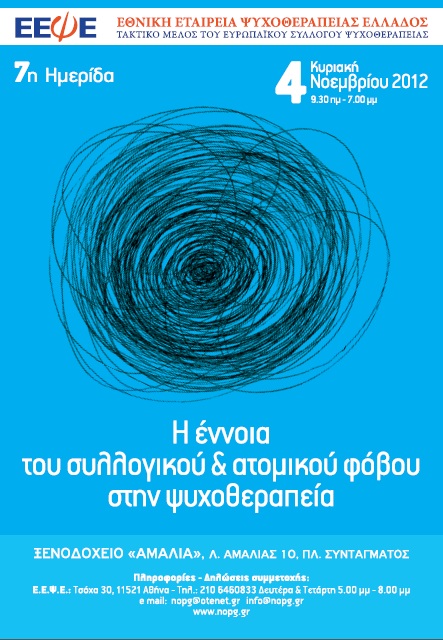
7η ΗΜΕΡΙΔΑ Ε.Ε.Ψ.Ε.

«Ἡ Έννοια του Συλλογικου καί Ατομικού Φόβου στην Ψυχοθεραπεία»

Κυριακή 4 Νοεμβρίου 2012

Ξενοδοχείο Αμαλία, Λεωφ. Αμαλίας 10, (πλ. Συντάγματος).

Πρόγραμμα

9.30-10.00 Προσέλευση – Εγγραφή

Εναρξη: Μαρία Χατζιδάκη

Χαιρετισμός εκ μέρους της Οργανωτικής Επιτροπής:  Mιχάλης Καλλιφρονάς

Χαιρετισμός Διοικητικού Συμβουλίου: Μιχάλης Αθητάκης Προέδρος ΔΣ ΕΕΨΕ

10.15- 11.00 Εισηγήσεις

Συντονιστής: Μιχάλης Καλλιφρονάς

· Προσκεκλημένη ομιλήτρια

«Φοβού τους Δαναούς και Δώρα φέροντας!» Οι φοβικές Επιδράσεις των ΜΜΕ – Ρόη Παναγιωτοπούλου

· Η επίδραση της οικονομικής, κοινωνικής και αξιακής κρίσης στη σχέση θεραπευτή-θεραπευόμενου – Μαρίνα Καλοτεράκη

11.00-12.00 Ερωτήσεις προς ομιλητές. Ανάδειξη και επεξεργασία θεμάτων σε ομάδες και συζήτηση στην ολομέλεια

Συντονιστές: Παυλος Ζαρογιάννης, Σοφια Πετρίδου

12.00-12.30 Διάλειμμα

12.30-14.00 Εργαστήρια

1. Τι θα κάνουμε με τους Δράκους ; Ο Φόβος, Αντίσταση στην Αυτονόμηση – Γιώτα Αντωνοπούλου και Βίκυ Ζέρβα Σπανού
2. Διασχίζοντας το Φόβο που ακινητοποιεί. Ένα Ταξίδι προς τη Συνειδητότητα με Οδηγό το Σώμα και Πυξίδα την Επιθυμία – Σαντρίνα Βάις και Ευτυχία Χριστοδήμου
3. Ο Φόβος Σύμμαχος στην προσωπική Ενδυνάμωση και την κοινωνική Αλληλεγγύη – Αλεξάνδρα Βασιλείου
4. Περπατώ εις το Δάσος όταν ο Λύκος είναι εδώ – Ευρώπη Παπαδοπούλου
5. Χρόνιο Άγχος : Το «καθημερινό» Πρόσωπο τού Φόβου. Δρόμοι Εξοικείωσης και Επεξεργασίας στην Τραυματοθεραπεία – Ζωή Παραδομενάκη Σίλλατ

14.00-15.30 Ελαφρύ γεύμα

15.30-17.00 Εργαστήρια

6. Αν φοβάσαι μη μιλάς. Αν μιλήσεις μη φοβάσαι . Δραματοθεραπευτικός Διάλογος με τον ατομικό και το συλλογικό Φόβο – Ανθή Κασταμονίτου και Γιασμίνα Βουνάτσου.
7. Εμψύχωση Ομάδας με την μη κατευθυντική παρεμβατική Μέθοδο πάνω στον ατομικό και συλλογικό Φόβο – Σεβαστιάνα Κουτρουμπάνου
8. «Είμαι ο Φόβος και είμαι εντάξει! Το δύσκολο Συναίσθημα του Φόβου, μας προσκαλεί να μην το φοβηθούμε και να το κατανοήσουμε…» – Μαρία Μαραγκοπούλου
9. Εμπιστοσύνη και Φόβος στην ψυχοθεραπεία – Ευσταθία Θεοδώρου
10. Όταν ο συλλογικός Φόβος συναντάει τον ατομικό. Τα Δωμάτια του Φόβου στο Σώμα μας – Κωστής Γκουρτσούλης και Ιωάννα Χαραλάμπους

17.00-17.30 Διάλλειμα

17.30–18. 15 Εισηγήσεις

Συντονιστής: Αλκης Ξανθάκης Τερτσέτης

· Το Σώμα ως Πεδίο Εγγραφής του Φόβου – Σάββας Αλεξόγλου

· Ο Φόβος φυλάει τα …έρμα – Κωνσταντίνα Εικοσιπεντάρχου

· Η Οιδιπόδεια Εμπειρία και ο Φόβος – Θανάσης Γεωργάς

18.15-19.00 Ολομέλεια με ερωτήσεις και κλείσιμο

Συντονιστές: Παυλος Ζαρογιάννης, Σοφία Πετρίδου

Εδώ το αναλυτικό πρόγραμμα της ημερίδας

Πληροφορίες – Δηλώσεις συμμετοχής:

Το κόστος συμμετοχής είναι 50 ευρώ μέχρι τη Δευτέρα 15 Οκτωβρίου και 60 ευρώ (απο τις 16 Οκτωβρίου εως τις 4 Νοεμβρίου και συμπεριλαμβάνει συνεχόμενο καφέ και βουτήματα, όπως και ελαφρύ γεύμα κατά την μεσημβρινή διακοπή. Για τους εκπαιδευόμενους και φοιτητές το κόστος συμμετοχής είναι 30 ευρώ

Ε.Ε.Ψ.Ε. 210-6460833 Δευτέρα & Τετάρτη 5.00-800 μ.μ.

e-mail: info@nopg.gr και nopg@otenet.gr

Oct 032012
 

Ο Bruce Levine, Ph.D., μιλά για τη σχέση της ψυχολογίας με τις δομές εξουσίας. Μια σχέση διαχρονική και επικίνδυνη. Αξίζει μια ανάγνωση, μάλλον πολλές αναγνώσεις.

Πηγή: Mad in America

How Psychologists Meet the Needs of the “Power Structure”: A Talk at the Psychologists for Social Responsibility Conference

By the 1980s, as a clinical psychology graduate student, it had become apparent to me that the psychology profession was increasingly about meeting the needs of the “power structure” to maintain the status quo so as to gain social position, prestige, and other rewards for psychologists.

The Backward March of Psychologists

The academic psychology that I entered as a psychology major in the 1970s was by no means perfect. There was a dominating force of manipulative, control-freak behaviorists who appeared to get their rocks off conditioning people as if they were rats in a maze. However, there was also a significant force of people such as Erich Fromm who believed that an authoritarian and undemocratic society results in alienation, and that this was a source of emotional problems. Fromm was concerned about mental health professionals helping people to adjust to a society with no mind to how dehumanizing that society had become. Back then, Fromm was not a marginalized figure; his ideas were taken seriously as he had best sellers such as The Art of Loving, and he appeared on national television.

However, by the time that I received my Ph.D. in 1985—from an American Psychological Association approved clinical psychology program—people with ideas such as Fromm’s were at the far margins. By then, the focus was the competition as to what treatment could get patients back on the assembly line quickest. The competition winners that emerged, owing much more to public relations than science, were cognitive-behavioral therapy in psychology and biochemical psychiatry in psychiatry. By the mid-1980s, psychiatry was beginning to become annexed by pharmaceutical companies and forming what we now have, a “psychiatric-pharmaceutical industrial complex.” And increasingly marginalized was the idea that treatment that consisted of manipulating and medicating alienated people to adjust to this crazy rat race and thus maintain the status quo was a political act, a problematic one for people who cared about democracy.

My “Tactical Withdrawal” from Mainstream Psychology

After graduating, it seemed clear to me that academic clinical psychology and psychiatry departments, hospitals, and the mainstream clinical institutional worlds were going to depress, damage, and enrage me more than I was going to make a dent in reforming them, so I made a “tactical withdrawal” into private practice. Only several years later, in the late 1990s, did I begin to go public—writing articles and books, giving media interviews and talks about the problems in the mental health profession.

A major motivation for my going public was that I was embarrassed by the direction of my profession, and I wanted to separate myself from it. I remember thinking, half seriously, that when all these kids who were having a difficult time fitting into dehumanizing environments and who were getting increasingly drugged—first with psychostimulants and then with antidepressants and antipsychotics—grew up and figured out what had happened to them, they would get pretty enraged; and if ever there was a revolution and it resembled the French Revolution, then instead of kings, queens, and priests’ heads being placed in guillotines, it would be shrinks’ heads; and I thought that if I spoke out, maybe I might get spared.

Over the years, I discovered a handful of other psychologists and even a few courageous psychiatrists who were also speaking out against mainstream psychology and psychiatry, and most of them have paid a severe professional price of marginalization. I also came across psychologist authors who were not routinely discussed by mainstream mental health professionals but whom I respected. One such psychologist author/activist was Ignacio Martin-Baró.

Martin-Baró was a social psychologist and priest in El Salvador who popularized the term “liberation psychology” and who was ultimately assassinated by a U.S. trained Salvadoran death squad in 1989. Most U.S. psychologists are unaware of him, though he is known to many of you here at this Psychologists for Social Responsibility conference.

One observation by Martin-Baró about U.S. psychology was that “in order to get social position and rank, it negotiated how it would contribute to the needs of the established power structure.” We can see that in many ways. I want to start with the most visible evidence of this at the tip of the iceberg, but I also want to talk about the more submerged part of this iceberg that may even be more troubling for democracy and democratic movements.

Meeting the Needs of the Power Structure: The Tip of the Iceberg

On the obvious level, we can see psychologists meeting the needs of the power structure for social position and rank in the recent policies of the American Psychological Association (APA). For several years, the APA not only condoned but actually applauded psychologists’ assistance in interrogation/torture in Guantánamo and elsewhere. When it was discovered that psychologists were working with the U.S. military and the CIA to develop brutal interrogation methods, the APA assembled a task force in 2005 to examine the issue and concluded that psychologists were playing a “valuable and ethical role” in assisting the military. And in 2007, an APA Council of Representatives retained this policy by voting overwhelmingly to reject a measure that would have banned APA members from participating in abusive interrogation of detainees. It took until 2008 for APA members to vote for prohibiting consultations in interrogations.

Also at the tip of this iceberg of how psychologists have met the needs of the power structure are the efforts of perhaps the most famous academic psychologist in the U.S., who is also a former president of the APA, a man who once did some worthwhile work with learned helplessness. Of course, I’m talking about Martin Seligman, who more recently has consulted with the U.S. army’s Comprehensive Soldier Fitness program—this for not only social position and rank but for several million dollars for his University of Pennsylvania Positive Psychology Center, according to the Philadelphia Inquirer, which quoted Seligman saying, “We’re after creating an indomitable military.”

To give you an example of how positive psychology is used in this Comprehensive Soldier Fitness program, in one role play, a sergeant is asked to take his exhausted men on one more difficult mission, and the sergeant is initially angry saying that “It’s not fair”; but in the role play, he’s “rehabilitated” to reframe the order as a compliment, concluding, “Maybe he’s hitting us because he knows we’re more reliable.”

This kind of “positive reframing” and the use of psychology and psychiatry to manipulate and medicate people— one in six U.S. armed service members are taking at least one psychiatric drug, many in combat zones —so as to adjust to dehumanizing environments has concerned many critical thinkers for quite some time, from Aldous Huxley in Brave New World, to Erich Fromm in The Sane Society, to more recently, Barbara Ehrenreich in Bright-Sided.

The Submerged Iceberg: How Psychologists Subvert Democratic Movements

I want to turn now to the more submerged, less visible but more ubiquitous ways that psychologists are meeting the needs of the power structure and subverting democracy and democratic movements.

One major area that concerns me is the everyday pathologizing and diseasing of anti-authoritarians. This is quite scary because anti-authoritarians are absolutely vital for democracy and democratic movements. I want to talk about how this is being done, but first let me define authoritarianism and anti-authoritarianism

Authoritarianism is unquestioning obedience to authority. Authoritarians in control demand unquestioning obedience, and authoritarian subordinates give them that unquestioning obedience. In contrast, anti-authoritarians question the legitimacy of an authority before taking it seriously. Does the authority know what it’s talking about or not? Does it tell the truth or lie? Does it care about the people who are taking it seriously or is it exploitative? And if anti-authoritarians assess an authority to be illegitimate, they then challenge and resist it.

So, of course anti-authoritarians are essential for democracy and democratic movements. And by pathologizing and “treating” anti-authoritarians, psychologists and other mental health professionals are taking them off “democracy battlefields.”

I began to think about this problem of psychologists pathologizing anti-authoritarians when I was in graduate school in the early 1980s. Prior to that, in 1970s—when mental health professionals were moving forward instead of backward—psychiatry, in response to the pressure of gay activists, had removed homosexuality as a mental illness from their diagnostic bible, the DSM. But 1980 was a sad year—Erich Fromm died, Ronald Reagan became president, and the DSM III was published in 1980, my second year of graduate school.

The DSM III was a huge expansion of psychiatric disorders, with many more child and adolescent diagnoses, and I immediately noticed that the DSM III was pathologizing stubbornness, rebellion, and anti-authoritarianism. Some of these new diagnoses subtly pathologized rebellion, but one diagnosis was in-your-face obvious pathologizing of rebellion—“oppositional defiant disorder” (ODD).

For those of you who are not clinicians, ODD kids are not doing anything illegal. ODD kids are not the kids who once were labeled “juvenile delinquents”—that’s “conduct disorder.” No, the official symptoms of ODD include “often actively defies or refuses to comply with adult requests or rules” and “often argues with adults.”

When I discovered ODD, I told some of my professors that I was already a little embarrassed by the profession but now I’m really embarrassed—didn’t psychologists realize that just about every great American activist from Saul Alinsky to Harriet Tubman, to many great artists and scientists, to scientist-activists such as Albert Einstein would have been diagnosed with ODD? In response, they diagnosed me as having “issues with authority.” I definitely do have issues with authorities who don’t know what the hell they are talking about—this another reason that I withdraw from the mainstream mental health professional world.

Anti-Authoritarians Kept Off Democracy Battlefields

So, I went into private practice, and I have received many referrals for these teenagers diagnosed with ODD from colleagues who are uncomfortable with these kids. As I worked with these kids, I found that not only did I like most of them but I also respected the vast majority of them, as they have real courage. They don’t comply with authorities whom they consider to be illegitimate, and most of the time, I concur with their assessment. If they do respect an authority, they aren’t obnoxious, and usually they clamor for adults whom they can respect and who genuinely respect them. Not only are these kids not mentally ill, many of them are what I consider to be the hope of the nation.

Over the years, I have worked not only with ODD teens but also with adults diagnosed with depression, anxiety disorder, and substance abuse, and with psychiatric survivors who have been previously diagnosed with various psychoses. What’s impossible for me to ignore is how many of these individuals diagnosed with mental disorders are essentially anti-authoritarians. It began to be increasingly clear to me that this was potentially a large army of anti-authoritarian activists that mental health professionals are keeping off democracy battlefields by convincing them that their depression, anxiety, and anger are solely a result of their mental illnesses and not, in part, a result of their pain over being in dehumanizing environments.

Earlier this year, I wrote a piece for AlterNet called “Would We Have Drugged Up Einstein?” about why anti-authoritarians are diagnosed with mental illness, and it was picked up by several other Internet zines. I received a huge response, including many emails from people who have been diagnosed with depression and anxiety disorder who positively resonated with this particular sentence: “Often a major pain of their lives that fuels their anxiety and/or depression is fear that their contempt for illegitimate authorities will cause them to be financially and socially marginalized, but they fear that compliance with such illegitimate authorities will cause them existential death.”

So, over the years, I have become increasingly confident that there is huge group, a potential army of anti-authoritarian activists who are being pacified by the mental health profession and taken off democracy battlefields. And this, I think, is one important reason why the number of Americans actively involved in democratic movements is so low.

Of course this is not the only reason for political passivity in the United States, as there are many spokes on the U.S. political passivity wheel. The decimation of labor unions disempowering working people, as 35% of working people in the 1950s were in unions, compared to 12% today and only 7% among non-public employees. Increased workplace surveillance to go along with government surveillance which pacifies people. Social isolation—25% of Americans don’t have a single confidante in their lives—preventing even the possibility of solidarity. Staggering student-loan debt, which breaks young people’s spirit of resistance. Extremist consumerism that weaken us. And so forth. But the pacifying spoke in the wheel that I feel the greatest obligation to talk about most loudly is how our mental health profession is taking anti-authoritarians off democracy battlefields.

Psychologists’ Unavoidable Political Choice

If you look at the history of top-down hierarchical civilization, the reality is that there have always been power structures. There has been the ruling power structure of the combination of the monarchy and the church. And today in the U.S. and many other nations, the ruling power structure is the corporatocracy—giant corporations, the wealthy elite, and their politician collaborators.

All power structures throughout history have sought to use groups of people, especially among so-called professionals, who will control the population from rebelling against injustices. Power structures have used clergy—that’s why clergy who cared about social justice and who were embarrassed by their profession created “liberation theology.” Power structures have certainly used police and armies, as has been done throughout American history to try to break the U.S. labor movement. And the U.S. power structure now uses mental health professionals to manipulate and medicate people to adapt and adjust and thereby maintain the status quo, regardless of how insane the status quo has become.

So, mental health professionals have a choice. They can meet the needs of the power structure by only focusing on adjusting and adapting to what I think is an increasingly insane U.S. society. By insane I mean multiple senseless wars that Americans don’t even know why we are fighting. By insane I mean prisons-for-profit corporations such as Correction Corporation of America buying prisons from states and demanding in return a 90% occupancy guarantee—this actually occurred recently in my state of Ohio. And so on.

Or mental health professionals can act very differently. Clinicians can recognize that many among their clientele diagnosed with depression, anxiety disorder, and substance abuse are not essentially biochemicaly ill but are essentially anti-authoritarians. Not all of them are anti-authoritarians but many of them are. And that self-destructive behaviors are fueled by a variety of pains, one such pain is the direct and indirect impact of illegitimate authorities at all kinds of levels in people’s lives. And pained anti-authoritarians can be exposed to the idea that throughout history many people, famous and not-so-famous, from Buddha to Malcolm X, have transformed their pain and their self-destructive behaviors to constructive behaviors through art, spirituality, and also activism.

And once anti-authoritarians have their pain and their anti-authoritarianism validated and feel more whole, they are likely to become less on the defensive and more secure. That’s when the real fun begins, as we can move to the next level—we can learn to get along with one another. When anti-authoritarians regain the energy to do battle with the corporatocracy and learn to get along with one another, watch out—we might actually achieve something closer to democracy in the United States.

Bruce E. Levine, a practicing clinical psychologist, writes and speaks about how society, culture, politics and psychology intersect. His latest book is Get Up, Stand Up: Uniting Populists, Energizing the Defeated, and Battling the Corporate Elite. His Web site is www.brucelevine.net. This article is also being simultaneously published in the October Z Magazine.

Oct 032012
 

Έχουν αποτέλεσμα τα αντικαταθλιπτικά; Από την εμφάνιση του Prozac στη δεκαετία του 1980, οι συνταγές για αντικαταθλιπτικά έχουν εκτοξευθεί στα ύψη 400% (στην Αμερική μόνο), με 17 εκατομμύρια Αμερικάνους να λαμβάνουν επί του παρόντος κάποια μορφή του φαρμάκου. Αλλά πόσο καλό κάνει το φάρμακο το ίδιο; “Η διαφορά ανάμεσα στο αποτέλεσμα ενός εικονικού φαρμάκου και την επίδραση ενός αντικαταθλιπτικού είναι ελάχιστη για τους περισσότερους ανθρώπους», λέει ο επιστήμονας του Χάρβαρντ Irving Kirsch. Αξίζει να ακούσεις τη συνέντευξη του στο CBS… Ο διάλογος συνεχίζεται. Είναι πολλά τα λεφτά που επενδύονται στη βιομηχανία ψυχοφαρμάκων – και αυτό δυσκολεύει την αντικειμενική έρευνα, αλλά και σοβαρή η ανακούφιση που χρειάζονται όσοι υποφέρουν από κατάθλιψη.

Sep 202012
 

ΣΩΜΑΤΕΙΟ ΕΡΓΑΖΟΜΕΝΩΝ

ΣΤΗΝ ΠΑΝΕΛΛΑΔΙΚΗ ΕΝΩΣΗ ΓΙΑ ΤΗΝ ΨΥΧΟΚΟΙΝΩΝΙΚΗ ΑΠΟΚΑΤΑΣΤΑΣΗ ΚΑΙ ΤΗΝ ΕΠΑΓΓΕΛΜΑΤΙΚΗ ΕΠΑΝΕΝΤΑΞΗ

(Σ.Ε.Π.Ε.Ψ.Α.Ε.Ε.)

Κιλκίς 8 Κορυδαλλός, Τ.Κ. 18120, Τηλ. & FAX 2104968988, email: sepepsaee@yahoo.gr

Συνάδελφοι – συναδέλφισσες,

Με την παρούσα επιστολή σας ενημερώνουμε για την αποφάσεις που έλαβαν τα μέλη του σωματείου εργαζομένων στην ΠΕΨΑΕΕ στις Γενικές τους Συνελεύσεις της 31ης Αυγούστου και της 14ης Σεπτεμβρίου.

H συνεχής υποχρηματοδότηση από τον κρατικό προϋπολογισμό είναι γνωστή σε όλους, άλλωστε τα τελευταία χρόνια το να δουλεύουμε απλήρωτοι για μεγάλες περιόδους έχει γίνει καθεστώς. Τη χαριστική βολή έδωσε φέτος η μείωση κατά 55% του προϋπολογισμού σε σχέση με τον περσινό, που σημαίνει πως οι πόροι για τη διατήρηση των δομών ψυχικής υγείας έχουν ήδη εξαντληθεί και με μεγάλη μας λύπη διαπιστώνουμε ότι δεν υπάρχει κάποια έστω ένδειξη από την πολιτική ηγεσία του υπουργείου ότι έχει κάνει κάποια ενέργεια για να καλύψει το υπόλοιπο μέχρι το τέλος του 2012. Αυτό πρακτικά σημαίνει ότι οι εργαζόμενοι στην Π.Ε.Ψ.Α.Ε.Ε. έχουν να πληρωθούν από τον Μάιο του 2012 και τους οφείλονται μέχρι αυτή την στιγμή 3 1/2 μισθοί.

Μέσα σε αυτό το εξαιρετικά δυσμενές πλαίσιο, οι εργαζόμενοι δίνουμε έναν καθημερινό αγώνα για να μπορούμε να βρισκόμαστε στις δουλειές μας και να προσφέρουμε υπηρεσίες ψυχικής υγείας στους ανθρώπους που τις έχουν ανάγκη. Καλούμαστε να δουλέψουμε μέσα σε ένα κλίμα ανασφάλειας και εργασιακής εξουθένωσης, νιώθουμε καθημερινή πια αβεβαιότητα για το αν θα επιβιώσουν ή όχι οι δομές στις οποίες εργαζόμαστε, η προσθήκη νέων αντικειμένων εντατικοποιεί την εργασία, συνάδελφοι αποχωρούν και δεν αναπληρώνονται, η κάλυψη βασικών λειτουργικών δαπανών γίνεται όλο και πιο δύσκολη, και όλα αυτά εν μέσω επαπειλούμενων αποφάσεων που προβλέπουν μειώσεις αποδοχών.

Πλέον τίθεται θέμα επιβίωσης όχι μόνο για την ψυχιατρική μεταρρύθμιση αλλά και για εμάς τους ίδιους, καθώς δυσκολευόμαστε να ανταποκριθούμε σε καθημερινές βιοποριστικές ανάγκες.

Για μας είναι ξεκάθαρο ότι η μόνη λύση είναι να παλέψουμε όλοι μαζί και μαζί με εργαζόμενους από άλλους χώρους της ψυχικής υγείας, τους λήπτες των υπηρεσιών μας και τις οικογένειές τους για να αποτρέψουμε την εγκατάλειψη της ψυχιατρικής μεταρρύθμισης και να διεκδικήσουμε αξιοπρεπείς συνθήκες εργασίας και σεβασμό στα δικαιώματα των ληπτών και στην ποιοτική παροχή υπηρεσιών.

Στις γενικές μας συνελεύσεις, συνυπολογίζοντας όλα τα παραπάνω αποφασίσαμε και ήδη πραγματοποιήσαμε προειδοποιητική πενθήμερη τετράωρη στάση εργασίας από τις 10 ως τις 14 του μήνα, διεκδικώντας την άμεση καταβολή των δεδουλευμένων μας.

ΚΑΙ ΣΥΝΕΧΙΖΟΥΜΕ!!!!

ΠΡΑΓΜΑΤΟΠΟΙΟΥΜΕ 5ΝΘΗΜΕΡΗ ΑΠΕΡΓΙΑ ΑΠΟ ΤΙΣ 17 ΣΕΠΤΕΜΒΡΙΟΥ – 21 ΣΕΠΤΕΜΒΡΙΟΥ

ΑΓΩΝΙΖΟΜΑΣΤΕ ΓΙΑ

  1. την διασφάλιση της λειτουργίας των δομών με επιχορήγηση για το έτος 2012 καθώς και την αύξηση του προϋπολογισμού για το 2013, ώστε να επιβιώσουν οι δομές και να ανταποκρινόμαστε στις ολοένα και αυξανόμενες ανάγκες για υπηρεσίες ψυχικής υγείας μιας κοινωνίας σε ανθρωπιστική κρίση.
  2. ένα σύστημα ψυχικής υγείας που θα παρέχει ποιοτική και δωρεάν φροντίδα στους συνανθρώπους μας που έχουν ανάγκη, στη κατεύθυνση της αποϊδρυματοποίησης και της κοινοτικής φροντίδας.
  3. άμεση καταβολή των δεδουλευμένων στους εργαζόμενους στον χώρο της Ψυχικής Υγείας

Καλούμε όλους τους συναδέλφους που εργάζονται στον χώρο της Ψυχικής Υγείας να συμμετέχουν μαζικά στις κινητοποιήσεις που πραγματοποιούνται.

Συμμετέχουμε μαζικά στην Γενική Απεργία Γ.Σ.Ε.Ε. – Α.Δ.Ε.Δ.Υ. της 26ης Σεπτεμβρίου – Διαδηλώνουμε όλοι μαζί με το μπλόκ της Ψυχικής Υγείας στην πορεία (σημείο συγκέντρωσης έξω από το Υπουργείο Υγείας).

Sep 012012
 

(φωτογραφία www.vinchen.com)

Επιστολή του Σωματείου Εργαζομένων ‘Περιβολάκι’ στα πολιτικά κόμματα

Προς:

  • Νέα Δημοκρατία
  • Συνασπισμό ΡΙΖοσπαστικής Αριστεράς
  • Πανελλήνιο ΣΟσιαλιστικό Κίνημα
  • Ανεξάρτητους Έλληνες
  • Δημοκρατική Αριστερά
  • Κομμουνιστικό Κόμμα Ελλάδας

Κοινοποίηση σε:

  • Καθημερινή
  • Το Βήμα
  • Αυγή
  • Ριζοσπάστης
  • Εργατικό Κέντρο Αθήνας
  • Γενική Συνομοσπονδία Εργατών Ελλάδας
  • Ελληνική Ψυχιατρική Εταιρεία
  • Σύλλογος Ελλήνων Ψυχολόγων
  • Παρατηρητήριο για τα Δικαιώματα στην Ψυχική Υγεία

ΣΩΜΑΤΕΙΟ ΕΡΓΑΖΟΜΕΝΩΝ ‘ΠΕΡΙΒΟΛΑΚΙ’

Ύδρας 25, Χαλάνδρι, 15232

Χαλάνδρι, 29 Αυγούστου 2012


Αξιότιμες κυρίες, αξιότιμοι κύριοι,

Ως εργαζόμενοι στο χώρο της ψυχοκοινωνικής φροντίδας στην Ελλάδα σας απευθύνουμε αυτή την επιστολή για να εκθέσουμε την κατάσταση που επικρατεί αυτή τη στιγμή στις υπηρεσίες μας και για τους ανθρώπους που εμπλέκονται καθημερινά, μετά από δύο χρόνια εφαρμογής του μνημονίου στη χώρα μας.

Οι υπηρεσίες πρόληψης, θεραπείας και αποκατάστασης ψυχικών νοσημάτων κρέμονται από μία κλωστή. Η ψυχιατρική μεταρρύθμιση έχει καταρρεύσει προ πολλού. Τα δικαιώματα και οι ζωές των ασθενών παραβιάζονται ως συνέπεια κλεισίματος και συγχωνεύσεων δομών και μονάδων φροντίδας, εξαιτίας των βάρβαρων περικοπών σε πόρους και επαγγελματίες ψυχικής υγείας. Το 1989 οι εικόνες των ασθενών που δένονταν γυμνοί με ιμάντες στα κρεβάτια, έκαναν ομαδικό μπάνιο με λάστιχο και άλλες σκηνές φρίκης, έκαναν τον γύρο του κόσμου σοκάροντας με την απανθρωπιά των συνθηκών νοσηλείας που επικρατούσαν στο ψυχιατρείο – κολαστήριο της Λέρου. Ενδεικτικό της κατάστασης που επικρατεί σήμερα είναι όσα παραθέτονται σε επίσημο έγγραφο της διοίκησης του Κρατικού Ψυχιατρείου Λέρου που φέρνει και πάλι στην επικαιρότητα τις μνήμες του 1989. Εν έτη 2012, οι τρόφιμοι κινδυνεύουν να χάσουν τη ζωή τους από ασιτία την ώρα που – βάσει νόμου (Ν. 2071/92 ΦΕΚ 123/92 τ.α , άρθρο 47) – «ο ασθενής έχει το δικαίωμα της παροχής φροντίδας σε αυτόν με τον οφειλόμενο σεβασμό στην ανθρώπινη αξιοπρέπεια του. Αυτή η φροντίδα περιλαμβάνει όχι μόνο την εν γένει άσκηση της ιατρικής και της νοσηλευτικής, αλλά και τις παραϊατρικές υπηρεσίες, την κατάλληλη διαμονή, την κατάλληλη μεταχείριση και την αποτελεσματική διοικητική και τεχνική εξυπηρέτηση». Oι γιατροί της Λέρου, από τις 5 Ιουνίου, έχουν ενημερώσει εγγράφως το Υπουργείο Υγείας – με αρ. πρωτοκόλλου 5779 και με το χαρακτηρισμό του “εξαιρετικά επείγοντος” – ότι το Κρατικό Ψυχιατρείο της Λέρου, αδυνατεί να ταΐσει τους 350 ασθενείς, εξαιτίας των χρεών του ιδρύματος προς τους προμηθευτές, οι οποίοι έχουν σταματήσεις τις παραδόσεις σε τρόφιμα. Η έκφραση «ανθρωπιστική κρίση» μπορεί να μην φτάνει για να περιγράψει τη μαζική εξόντωση στην οποία εξωθείται, λόγω των αλλεπάλληλων μέτρων, ένας ολόκληρος –ο πιο ευαίσθητος- πληθυσμός. Μάλιστα, στην πιο δύσκολη περίοδο, αυτή της οικονομικής κρίσης, που σοβαρότατες ψυχικές ασθένειες όπως κατάθλιψη παρουσιάζουν δραματική αύξηση, το κοινωνικό κράτος αντί να ενισχύεται καταργείται. Αυτό είναι κάτι που το καταγγέλλουμε και θα συνεχίσουμε να το καταγγέλλουμε με κάθε δυνατό τρόπο.

Οι μόνοι που σηκώνουμε το βάρος διατήρησης μιας υποτυπώδους προσφοράς υπηρεσιών ψυχικής υγείας, τόσο στους ενήλικους ασθενείς εντός και εκτός στεγαστικών δομών, όσο και στα παιδιά και τους έφηβους με σοβαρές αναπτυξιακές διαταραχές, είμαστε εμείς, οι απλήρωτοι εργαζόμενοι. Σημειώνουμε ότι έχουν υπάρξει περικοπές σε μισθούς των 1000 και 900 ευρώ, ενώ έχουμε από το 2005 υπάρξει πολλές φορές απλήρωτοι για περιόδους που έχουν φτάσει και τους 9 μήνες(!). Επίσης, η μείωση 55% του προϋπολογισμού που έχει ανακοινωθεί για το τρέχον έτος σημαίνει πως τα χρήματα για τη διατήρηση των δομών ψυχικής υγείας ήδη εξανεμίστηκαν προ πολλού.

Όσον αφορά το χώρο μας, οι 43 από του 78 έμπειρους επαγγελματίες Ψυχικής Υγείας, οι οποίοι, μέχρι τον Ιούλιο 2012, εργαζόμασταν στις τρεις δομές του Περιβολάκι (ΝΠΙΔ χρηματοδοτούμενο από το ΥΥΚΑ, που παρέχει υπηρεσίες σε παιδιά με διάχυτες αναπτυξιακές διαταραχές, δηλ αυτισμό, παιδική ψύχωση κλπ. και στις οικογένειές τους, στο πλαίσιο του Ψυχαργώς), είμαστε κυριολεκτικά στον αέρα. Δυστυχώς, η διοίκηση του Περιβολάκι μεθόδευσε με τρόπο αυθαίρετο και χωρίς καμία διαφάνεια το κλείσιμο των δύο δομών του στο Χαλάνδρι, στερώντας από τον πληθυσμό που εξυπηρετούσε: Α) Κέντρα Ημέρας, Β) το μοναδικό στην Ελλάδα Ξενώνα βραχείας διαμονής και Γ) την Ομάδα Διάγνωσης και Αξιολόγησης. Επέλεξε να παραδώσει μέρος του επιστημονικά καταρτισμένου και έμπειρου προσωπικού στο ΥΥΚΑ με δυο άδεια από εξοπλισμό κτήρια, χωρίς αντικείμενο εργασίας, αφήνοντας στον αέρα εργαζόμενους που έχουν στηρίξει τον φορέα πολλά χρόνια. Τα κριτήρια της επιλογής δεν κοινοποιήθηκαν, ενώ υπάρχουν εργαζόμενοι οι οποίοι αρνήθηκαν να παραμείνουν στην δομή. Τα παιδιά σχολικής ηλικίας παραπέμφθηκαν σε ειδικά δημόσια σχολεία – όπως απαιτεί ο νόμος για την ειδική αγωγή- παρόλο που τα σχολεία αυτά, κατ’ ομολογία και των συναδέλφων εκπαιδευτικών που εργάζονται σε αυτά και παρά τις συνεχείς προσπάθειες τους, αδυνατούν να καλύψουν τις ήδη υπάρχουσες ανάγκες, πόσο μάλλον ορισμένα ιδιαίτερα βαριά περιστατικά, ενώ τα υπόλοιπα παιδιά, προσχολικής ηλικίας θα μεταφερθούν στο Περιβολάκι 3, στην Παιανία, για να εξασφαλιστεί η λειτουργία του. Παράλληλα θα θέλαμε να επιστήσουμε την προσοχή σας στο γεγονός ότι αν και η διοίκηση του Περιβολάκι μαζί με το ΥΥΚΑ υπόσχονταν και δεσμευόταν ότι μέχρι τέλος Ιουλίου θα δρομολογούταν η μεταβίβαση, αφού υπήρξε ενδιαφέρον από άλλον φορέα να αναλάβει τις 2 δομές, ακόμα δε φαίνεται να έχουμε καμία εξέλιξη. Ως εργαζόμενοι θα συνεχίσουμε στο σύνολο μας να αγωνιζόμαστε να διατηρηθούν οι υπηρεσίες της Ψυχικής Υγείας σε ένα τόσο ευαίσθητο κλινικά πληθυσμό.

Καταγγέλλουμε τη διοίκηση Περιβολάκι και τους επιστημονικά υπευθύνους που πήραν αυτές τις αποφάσεις για συρρίκνωση των υπηρεσιών στον πιο ευαίσθητο πληθυσμό των παιδιών, αλλά και το ΥΥΚΑ που το επιτρέπει. Τα Υπουργεία Υγείας όλα αυτά τα χρόνια, άλλωστε, επιδίωκαν τη συρρίκνωση των δομών με την επιλογή τους να μη χρηματοδοτούν επαρκώς και έγκαιρα τις υπηρεσίες ψυχικής υγείας, ιδιαίτερα όσες είχαν αναθέσει σε μη κερδοσκοπικά σωματεία ή σε αστικές μη κερδοσκοπικές εταιρίες. Άφησαν την ψυχική υγεία χωρίς κεντρικό σχεδιασμό και χωρίς ουσιαστικό έλεγχο σχετικά με την ποιότητα των υπηρεσιών αλλά και την οικονομική διαχείριση με αποτέλεσμα μεταξύ άλλων τη κακοδιαχείριση κονδυλίων. Σήμερα, επικαλούμενοι την κρίση και με μηδαμινή χρηματοδότηση για το 2ο εξάμηνο του 2012 ουσιαστικά μεθοδεύουν με τη σειρά τους το κλείσιμο των δομών ή τη μετατροπή τους σε άσυλα πάλι.

Επειδή θεωρούμε ότι οι υπηρεσίες αυτές δεν περισσεύουν στην κοινότητα, ειδικά την περίοδο αυτή, επειδή η χρηματοδότηση που δόθηκε για τις υποδομές και το σχεδιασμό των δομών από τα ευρωπαϊκά προγράμματα και το ελληνικό κράτος δόθηκε για να υπάρξει συνέχεια των αναγκαίων υπηρεσιών, επειδή οι υπηρεσίες δεν ανήκουν στη διοίκηση αλλά στα παιδιά και τις οικογένειες τους, σας ζητάμε να υποστηρίξετε τη μη διακοπή της λειτουργίας των δομών αυτών, όπου θα συνεχίσουν να εργάζονται οι έμπειροι επαγγελματίες του χώρου, ώστε να μη βρεθούν κι αυτοί στο ήδη μεγάλο πηγάδι της ανεργίας.

Εμείς, από τη μεριά μας θα παλέψουμε μαζί με εργαζόμενους, χρήστες υπηρεσιών και τις οικογένειες τους, από όσο το δυνατό περισσότερους χώρους της ψυχικής υγείας αλλά και από άλλους ευαίσθητους κοινωνικούς χώρους, καθώς και από το χώρο της υπόλοιπης υγείας για να αποτρέψουμε την έκπτωση του κοινωνικού κράτους. Οι πολιτικές του μνημονίου εξαθλιώνουν και σκοτώνουν κόσμο στο όνομα μιας σωτηρίας που δεν αφορά όμως εμάς.

Είμαστε στη διάθεσή σας για να σας ενημερώσουμε με κάθε λεπτομέρεια αν ενδιαφέρεστε να πάρετε θέση δίπλα μας στον αγώνα αυτό, γιατί μόνο αν κάθε διαθέσιμη φωνή δημοσιοποιήσει άμεσα το πρόβλήμα μας και βρεθεί συμπαραστάτης στους αγώνες μας υπάρχει ελπίδα να αποτρέψουμε το κοινωνικό έγκλημα που συντελείται.

Με εκτίμηση,

το Δ.Σ. του Σωματείου Εργαζομένων στο Περιβολάκι

Aug 272012
 

Πηγή: TVXS

«Εφεύρεση» των φαρμακευτικών οι ψυχικές ασθένειες των παιδιών

Σκληρή κριτική στα κέντρα ψυχικής υγείας και τις φαρμακευτικές εταιρείες, τις οποίες κατηγορεί ότι λανθασμένα χαρακτηρίζουν εκατομμύρια ανθρώπους ως ψυχικά ασθενείς προς όφελός τους, ασκεί ο Τζέρομ Κάγκαν, ψυχολόγος, ερευνητής του Χάρβαρντ και ειδικός στην ανάπτυξη των παιδιών.

Σε μια ψηφοφορία που πραγματοποίησαν το 2002 Αμερικανοί ακαδημαϊκοί, ο Τζερόμ Κάγκαν κατέλαβε την 22η θέση σε μια λίστα με τους 100 πιο διαπρεπείς ψυχολόγους του 20ου αιώνα, πάνω μάλιστα από τον Καρλ Γιουνγκ (23ος), πατέρα της αναλυτικής ψυχολογίας, και τον Ιβάν Παβλόφ (24ος), που ανακάλυψε την ομώνυμη εξάρτηση.

Ο Κάγκαν μελετά την εξελικτική ψυχολογία στο πανεπιστήμιο του Χάρβαρντ σε όλη του την επαγγελματική καριέρα. Επί δεκαετίες εξετάζει το πώς τα μωρά και τα μικρά παιδιά μεγαλώνουν, τα μετρά, τεστάρει τις αντιδράσεις τους και στη συνέχεια, αφού μάθουν να μιλούν, τους κάνει διαρκώς ερωτήσεις. Γι’ αυτόν τα μεγάλα ερωτήματα είναι: Πώς προκύπτει η προσωπικότητα; Με ποια χαρακτηριστικά γεννιόμαστε και ποια αναπτύσσονται με το χρόνο; Τι καθορίζει το αν κάποιος θα είναι ψυχικά ασθενείς στη ζωή του;

Αυτό που προκαλεί ιδιαίτερη εντύπωση όσον αφορά τον Κάγκαν είναι ότι ο ίδιος έχει επιτεθεί στο ίδιο του το επάγγελμα και πρόσφατα δημοσίευσε το βιβλίο του «Το Φάντασμα της Ψυχολογίας: Η Κρίση στο Επάγγελμα και ο Δρόμος της Επιστροφής». Σε αυτό, προειδοποιεί ότι η κρίση αυτή είχε καταστροφικές συνέπειες για εκατομμύρια ανθρώπους, που λανθασμένα έχουν διαγνωσθεί ότι πάσχουν από ψυχικές ασθένειες.

Ο κ. Κάγκαν μίλησε για το θέμα αυτό στο Spiegel OnLine (ολόκληρη η συνέντευξη στα Αγγικά εδώ):

Καθηγητά Κάγκαν, μελετάτε την ανάπτυξη των παιδιών επί 50 χρόνια. Στη διάρκεια αυτής της περιόδου, η ψυχική υγεία βελτιώνεται ή χειροτερεύει;

Ας πούμε ότι έχει αλλάξει. Ειδικά σε φτωχές οικογένειες, μεταξύ μεταναστών και μειονοτήτων, η ψυχική υγεία έχει χειροτερεύσει. Αντικειμενικά μιλώντας, οι έφηβοι σε αυτές τις ομάδες έχουν περισσότερες ευκαιρίες σήμερα σε σχέση με 50 χρόνια πριν, αλλά παραμένουν αγχωμένοι και συγχυσμένοι διότι οι ανισότητες στην κοινωνίες έχουν διευρυνθεί. Ο αριθμός των διαγνωσμένων περιπτώσεων σε διαταραχές ελλειμματικής προσοχής έχει αυξηθεί μεταξύ των φτωχών…

Τη δεκαετία του ’60, οι ψυχικές διαταραχές ήταν άγνωστες για τον κόσμο των παιδιών. Σήμερα, τα επίσημα στοιχεία αναφέρουν πως 1 στα 8 παιδιά στις ΗΠΑ είναι ψυχικά ασθενές.

Αυτό είναι αλήθεια, αλλά οφείλεται κυρίως σε ασαφείς διαγνωστικές πρακτικές. Ας επιστρέψουμε 50 χρόνια πίσω: έχουμε έναν 7χρονο που βαριέται στο σχολείο και αναστατώνει την τάξη. Τότε, τον αποκαλούσαν τεμπέλη. Σήμερα, λέγεται ότι πάσχει από Σύνδρομο Ελλειμματικής Προσοχής και Υπερκινητικότητας. Γι’ αυτό οι αριθμοί έχουν εκτοξευτεί.

Οι ειδικοί κάνουν λόγο για 5,4 εκατ. παιδιά στις ΗΠΑ που παρουσιάζουν συμπτώματα του Σύνδρομου Ελλειμματικής Προσοχής και Υπερκινητικότητας. Λέτε ότι αυτή η ψυχική διαταραχή είναι απλώς μια εφεύρεση;

Ακριβώς αυτό. Είναι μια εφεύρεση. Κάθε παιδί που δεν αποδίδει στο σχολείο στέλνεται στον παιδίατρο και ο παιδίατρος λέει: «Είναι Σύνδρομο Ελλειμματικής Προσοχής και Υπερκινητικότητας. Πάρτε Ritalin». Το πρόβλημα είναι ότι αν ένα φάρμακο είναι διαθέσιμο στο γιατρό, θα κάνει τη διάγνωση που ταιριάζει με αυτό.

Συνεπώς η αποκαλούμενη κρίσης ψυχικής υγείας στα παιδιά δεν είναι τίποτα άλλο παρά μια προσπάθεια εκφοβισμού;

Μπορούμε να αναρωτηθούμε: Τι σημαίνει ψυχική υγεία; Αν κάνεις συνεντεύξεις με παιδιά και εφήβους ηλικίας 12 – 19 ετών, το 40% θα το κατατάξεις στην κατηγορία των αγχωτικών και καταθλιπτικών. Αν όμως κοιτάξεις πιο προσεκτικά και δεις πόσοι από αυτούς επηρεάζονται σοβαρά από αυτό, θα καταλήξεις στο 8%. Το να χαρακτηρίζει κάθε παιδί που είναι μελαγχολικό ή αγχωτικό ως ψυχικά ασθενές είναι γελοίο. Οι έφηβοι αγχώνονται. Αυτό είναι φυσιολογικό. Δεν ξέρουν σε ποιο πανεπιστήμιο να πάνε, τους παράτησε ο δεσμός τους… Η θλίψη και το άγχος αποτελούν κομμάτια της ζωής όπως και ο θυμός και σεξουαλική απογοήτευση.

Τι σημαίνει στην πράξη αν εκατομμύρια παιδιά χαρακτηρίζονται λανθασμένα ψυχικά ασθενείς;

Κατά κύριο λόγο, περισσότερα χρήματα για τη φαρμακευτική βιομηχανία και περισσότερα χρήματα για τους ψυχιάτρους και τους ερευνητές.

Και τι σημαίνει για τα παιδιά;

Γι’ αυτά σημαίνει πως κάτι δεν πάει καλά και πως μπορεί να εξασθενίσει. Δεν είμαι ο μόνος ψυχολόγος που το λέει αυτό. Είμαστε όμως απέναντι σε μια πανίσχυρη συμμαχία: φαρμακευτικές που βράζουν δισεκατομμύρια και επαγγελματίες που ενδιαφέρονται μόνο για τους εαυτούς τους.

Πέρα από το Σύνδρομο Ελλειμματικής Προσοχής και Υπερκινητικότητας, μια δεύτερη επιδημία που πλήττει τα παιδιά είναι η κατάθλιψη. Το 1987, ένα στα 400 παιδιά στις ΗΠΑ έπαιρνε αντικαταθλιπτικά. Το 2002, η αναλογία ήταν 1 στα 40. Από ποια ηλικία μπορούμε να μιλάμε για παιδική κατάθλιψη;

Αυτή είναι μια δύσκολη ερώτηση. Στους ενήλικες, η κατάθλιψη είτε συνεπάγεται μια σοβαρή απώλεια, μια αίσθηση τύψης ή ένα συναίσθημα ότι δεν μπορείς να εκπληρώσεις ένα στόχο. Τα παιδιά προφανώς δεν είναι ακόμη ικανά για τέτοια συναισθήματα. Αλλά μετά την ηλικία των τριών ή τεσσάρων ετών, ένα παιδί μπορεί να αναπτύξει ένα είδος συναισθήματος τύψης και, αν χάσει τη μητέρα του σε αυτή την ηλικία, θα είναι θλιμμένο για λίγο. Οπότε, από εκείνη τη στιγμή και έπειτα, μια ήπια κατάθλιψη μπορεί να εμφανιστεί. Όμως το συναίσθημα του να μην μπορείς να πετύχεις έναν ζωτικό στόχο στη ζωή σου και η αίσθηση του να μην υπάρχει εναλλακτική αρχίζει να γίνεται σημαντικό μόνο από την εφηβεία και μετά. Και αυτή είναι άλλωστε και η ηλικία που οι επιπτώσεις της κατάθλιψης είναι περισσότερο εμφανείς.

Είναι όμως γεγονός ότι πιο μικρά παιδιά ολοένα και πιο συχνά λαμβάνουν αντικαταθλιπτικά…

Ναι, διότι απλώς τα φάρμακα είναι διαθέσιμα.

Οπότε εσείς θα καταργούσατε τελείως τη διάγνωση της κατάθλιψης σε παιδιά;

Όχι, δεν θα έφτανα ως εκεί. Αλλά αν μια μητέρα με την κόρη της επισκεφτεί έναν γιατρό και του πει ότι το κορίτσι ήταν παλιότερα πολύ πιο χαρούμενο, ο γιατρός πρέπει πρώτα απ’ όλα να ανακαλύψει το πρόβλημα. Πρέπει να δει μόνος του το κορίτσι, ίσως και κάνει και κάποια τεστ πριν της χορηγήσει φάρμακα και της κάνει ηλεκτροεγκεφαλογράφημα.

May 162012
 

Πηγή: Psychotherapy Networker

How to Harness this Great Motivator

By Susan Johnson

Neuroscientists have recently established that emotion is the prime organizing force shaping how we cope with challenges. Now psychotherapists are learning how to work with emotion, rather than trying to control it.

God guard me from those thoughts men think in the mind alone. He that sings a lasting song, thinks in a marrow-bone.—W. B. Yeats.

Mike leans forward, and in a low, intense voice, says, “Look. It wasn’t my idea to see a couples therapist. And I hear that this therapy you do is all about emotions. Well, that about counts me out. First, I don’t have them the way she does.” He points to his wife, Emma, who’s staring angrily at the floor. “Second, I don’t want to have them or talk about them. I work through problems by just staying cool. I hold on tight and use my little gray cells.” He taps his head and sets his jaw. “Just tell me what’s wrong with us—why she’s so upset all the time—and I’ll fix the problem. Just tell me what to say, and I’ll say it. We were just fine until we started to have kids and she started complaining all the time. All this spewing of ‘feelings’ just makes things worse. It’s stupid.” He turns away from me, and the silence is filled with the sound of his wife’s weeping.

The irony of this type of drama never fails to intrigue me. In one of the most emotional scenarios ever—a couple trying to talk about their distressed relationship—here’s a partner insisting that the solution to distress is to ignore the emotion! Worse still, I’m getting emotional! This client is upsetting me. I breathe in and get my balance. After all, I remind myself, what he’s saying is so normal.

Mental health professionals would agree with him. In fact, I agree with him, to some extent. Venting strong, negative emotion—usually called catharsis—is nearly always a dead end. More than that, most of us are wary of strong emotions. Emotions have traditionally been seen, by philosophers like René Descartes, for example, as part of our primitive animal nature and, therefore, not to be trusted. Reason, by contrast, has long been thought to reflect our higher spiritual self. In neuroscientific terms, the implication is that we’re at our best when we live out of our prefrontal cortex and leave our limbic brain behind. More specifically, emotion is often associated with disorganization and loss of control. As Latin author Publilius Syrus, known for his maxims, wrote in the first century B.C., “The sage will rule his feelings; the fool will be their slave.”

All this is now changing. We’re in the midst of a revolution, as far as emotion is concerned. Antonio Damasio, one of the great scholars in the emotion field, notes that this revolution began in the 1990s, when the inherent “irrationality” of emotion began to be questioned. We’re now at the point where emotion—the apparently crazy, irresponsible sleazebag of the psyche—has been identified as an inherently organizing force, essential to survival and the foundation of key elements of civilized society, such as moral judgment and empathy. Emotion shapes and organizes our experience and our connection to others. It readies us for specific actions; it’s the great motivator. As the Latin root of emotion, movere (to move) suggests, strong feelings literally move us to approach, to avoid, to act.

Way before this emotion revolution, many therapists accepted that there was more to emotion than simply learning to control it—that directly working with emotion was somehow central to the task of therapy. We recognized that old Publilius was wrong: it’s not always good to control your emotions rigidly, and it’s not always foolish to listen to them! The idea that some kind of “corrective emotional experience” was necessary for any kind of effective psychotherapy was repeated endlessly, at least in the more dynamic psychotherapies. But exactly what the key elements of this experience are and how we get there with our clients remains difficult to define.

Even with this more emotion-friendly attitude, it seems to me that, as a field, we still tend to err on the side of bypassing or containing emotion, rather than actively using it for change. For many years, this seemed to be particularly true in couples and family therapies. It makes sense, in that emotions are especially intense in difficult interactions with loved ones. Therapists have to deal with powerful attachment dramas, which unleash rivers of emotion in their clients, and their own emotional issues can be triggered as they watch these dramas unfold. Such therapists had better know their rivers, and how to swim! Otherwise, it’s safer to sit on the bank, hold on to the traditional distrust of emotion, and try to create change through purely cognitive or behavioral means. But these interventions may not be sufficient, given that emotion and emotional signals are the central organizing forces in intimate relationships and that changes in emotional responses, such as increased love and tenderness, are hard to generate if we don’t work with emotion directly.

For many of us, formal training doesn’t help much here. How many professional training programs—even now, when we know so much more about the significance of emotion—systematically teach how to understand emotion or to engage and use it to create transformation in clients? In clinical psychology programs, young therapists mostly seem to learn how to teach clients techniques for moderating out-of-control emotions. Even if we look at a master therapist who explicitly values emotion, such as the great Carl Rogers, we see less direct focus on emotion than we might expect. So it makes sense that many of us remain a little intimidated or off-balance in the face of the compelling experience of emotion. It’s difficult for us to embrace it as a positive force and use it as a powerful tool for shaping growth in our clients.

It’s self-evident that emotion is captivating. If we can tune in to and address clients’ deeper emotions, the therapy process is at once tangibly relevant, and they engage. Research tells us that when therapists help clients deepen emotion, clients attain better outcomes in therapy. When we shape powerful emotional interactions in Emotionally Focused Therapy (EFT), we see seismic shifts in the core interactions that define lifetime relationships. Emotion takes us to the heart of the matter. New emotional mosaics create new perceptions and meanings. Even more important, they move us—psychologically and physiologically—into new response modes. If we can become comfortable with the power of emotion, it becomes the therapist’s greatest ally, rather than a disruptive force to be contained.

Even if we view emotions as essentially problematic, damping them down or circumventing them is no small task. Therapists often try to defuse negative emotion with such techniques as structured skill-building exercises, but the emotion usually seeps through and takes over anyway. We’ve all seen empathy or positive communication exercises miss the mark when they’re done with flat facial expressions or hostile tones. Physiologically, the attempt to suppress emotion is hard work, often resulting in increasing arousal. James Gross, a key researcher in affect regulation, finds that interactional partners pick up on this increased arousal and become more agitated themselves. We can all relate to the argument that goes: “You’re mad,” “No, I’m not” (said with clenched teeth), “Yes, you are; I don’t even want to talk to you.” But perhaps even more important than the effort required to regulate emotion is the fact that new, positive ideas and actions that emerge in session remain peripheral, unless we feel their force and connect with them on an emotional level.

What do therapists need to know to harness the power of emotion in therapy sessions? I remember when I was an idealistic young therapist starting to work with couples and suddenly coming face-to-face with such tsunami-like emotion that, to be able to stay with and focus on the wave, I needed to see the order, the patterned structure of this experience. As I came to understand emotion better, I gained understanding about the way in which key emotions were constructed and processed. I became less intimidated and learned to embrace and ride the wave, using its force to create change. By learning about emotion, I was able to help clients order these experiences and use them positively in their lives.

I could do all of this because I’d been given a great map: I had Attachment Theory—a systematic framework for personality and relationship development—as a guide. This theory of self in relation to others places emotion and its regulation front and center. John Bowlby, its father, saw emotion as the great communicator. It gives us a “felt sense” of our own physiology—our “gut wisdom.” It connects us with our preferences and longings. It links us to others with lightning speed. For Bowlby, the dance of connection and disconnection with loved ones plays a pivotal role in defining who we are; emotion is the music that organizes this dance and gives it rhythm and shape.

In the case of Mike and Emma, I feel more grounded and calm when I can track exactly how Mike regulates his emotions: he dismisses and denies them. This affects how he frames his signals to his partner—a process that elicits particular negative emotional responses from her. These responses then confirm his need to “hold on tight” and deny his emotions. Emotions aren’t just inner sensations and impulses; they’re social scripts. Self and system are molded in an ongoing feedback loop, which neither Mike nor his partner are aware of. The attachment framework sets out the deep logic of seemingly unpredictable emotions and tells me how and why Mike and Emma deal with them the way they do. There are only so many ways to deal with emotional starvation and the universal experiences of rejection and abandonment. When I know the territory, I feel confident enough to explore the terrain.

What Is Emotion, Anyway?

Science suggests that emotion is anything but primitive and unpredictable. It’s a complex, exquisitely efficient information-processing system, designed to organize behavior rapidly in the interests of survival. It’s an internal signaling system, telling us about what matters in the flood of stimuli that bombard us and tuning us in to our own inner needs. Research with brain-damaged subjects shows that without emotion to guide us, we can’t make even the most elementary of decisions; we’re bereft of preferences and have nothing to move us toward one option rather than another.

Emotional signals, especially nonverbal, such as facial expression and tone of voice, communicate our intentions to others. Our brain takes just 100 milliseconds to detect and process the smallest change in a human face and just 300 milliseconds to mirror this change in our own body, so we literally “feel” another’s emotion. The fact that we can rapidly read intentions and coordinate actions has offered our species a huge evolutionary advantage. The ability to read six basic emotional expressions and assign the same meaning to these expressions is universal.

There’s a consensus among experts that these basic emotions are anger, sadness, joy, surprise, shame, and fear. In anger, for example, the stare becomes fixed, eyes widen, and the brows contract; the lips compress and the body tenses. The impulse is to mobilize and move toward the object of the emotional response, so as to take control or eliminate the obstacle. When a client sits in front of me and tells me she has no idea how she feels, it helps me immeasurably to know that, in all probability, she’s feeling her own version of one of these six core emotions.

We have evidence that just naming emotions—literally putting feelings into words—seems to calm down amygdala activity in the brains of subjects viewing negative emotional images or faces. So it may help us “trust” emotion and see it as a positive tool in psychotherapy if we can keep in mind the elements that make up an emotional experience. First, there’s a cue from the environment. This is followed by an initial general perception (such as “bad”) and orientation to this cue and physical arousal. The meaning of cues and sensations is further evaluated in a more reflective cognitive appraisal. All these things prime a “move”—a compelling action tendency. These reactions all happen inside the skin, but they don’t stay there. Emotion isn’t silent or hidden.

The signals that accompany this process create what psychologist and author Daniel Goleman calls a “neural duet” with others. Much of the time, this process is implicit and instantaneous. Mike turns away when Emma asks him about his day; Emma picks up this cue and her brain frames it as “bad” and “dangerous”; Emma’s heart rate speeds up, and her body tenses; she scans for what this means and hits on “I’m losing him, he doesn’t want me”; she moves closer to Mike and, in an intense voice, says, “You never want to talk to me, anyhow”; Mike hears anger, so he closes down and shuts her out.

Once the cue has occurred, all these elements are shaped by Emma. Part of my job as an experiential therapist is to tune in to just how she does this. In this distressed relationship, she constantly monitors Mike’s responses and is exquisitely sensitive to any potential rejection from him. At the first sign of rejection, her mammalian brain lights up in alarm. Neuroscience researcher Jaak Panksepp calls this alarm “primal panic.” The neural circuit used here is the accelerated pathway through the thalamus to the amygdala; information about the responsiveness of an attachment figure has enormous survival significance, so the slower route through the reflective prefrontal cortex is bypassed. The meaning Emma makes here—that she’s unloved and Mike is cold and mean—reflects experiences that remind her how dangerous it can be to reach for others. She moves close to lessen her sense of threat and pushes for a different response from her husband. He sees her as intrusive. When he moves away, he confirms her deeper fears, and so helps to shape her ongoing experience.

What’s missing from this version of Emma’s emotional drama is that she tries to regulate her emotion. Regulation isn’t something we do to emotion; it’s just part of the process. As Dutch psychologist Nico Frijda puts it, we’re continually shifting the balance between letting go and restraint. We have reactions to our initial sense of what’s going on, and we try to cope with them as they’re happening. This translates into different levels of emotional experience.

At the end of this drama, which takes six seconds at most, Emma explodes in reactive anger. If we were to stop the frame at her first visceral response, we’d call her emotion fear. Her overt anger is a response to her sense of threat. An emotionally focused therapist would see her anger as secondary and the fear as her primary emotion. If she could slow down and pay attention to her fear, her action tendency might be different; for example, she might ask for reassurance. She could also, conceivably, have reacted to her own fear by moving into numbing, especially if she’d accessed thoughts of hopelessness and helplessness as part of her search for meaning. But she doesn’t register her fear. When she talks about this drama in my office, she looks angry and blames her husband for his coldness.

Not only do we have different levels of emotion, we have reflexive emotions—emotions about our emotions. Clients often have deep anxiety about the catastrophe that awaits if they stay with their primary softer emotions, like sadness or fear. The general list of negative expectations can be framed as responses to the open-ended sentence, “If I become open and vulnerable, I’ll find that I’m. . . .” The answers—which can be summarized as the 4 D’s—are: defective, disintegrating, drowning, or dismissed. This list seems to cut across gender, class, and culture.

Clients express these fears as follows: “If I feel my softer, deeper emotions, this means that I’m weak or inadequate; others will see me this way and reject me”; “If I feel this, I’ll become more and more distressed; I’ll lose myself”; “If I feel this, the emotion will never go away—it’ll go on forever, and I’ll drown in it”; “If I feel this, no one will respond or be there to save me.”

I used to see clients’ expression of this kind of pain as a metaphor, but it’s more than this. Emotions “are of the flesh, and they sear the flesh,” said Frijda. Until recently, the parallels between emotional pain, such as rejection, and physical pain, like burning your arm, were thought to be purely because of shared psychological distress. Now it’s clear that there’s a neural overlap in the way we process and experience social and physical pain. Tylenol can reduce hurt feelings, and social support can lessen physical pain. As predicted by Attachment Theory, emotional isolation and the helplessness associated with it seem to be key features of this emotional pain. Our need for connection with others has shaped our neural makeup and the structure of our emotional life.

Once we can name implicit core emotions, track them through our clients’ nonverbal communication, and thus create an integrated emotional experience by identifying all the elements and placing them in an attachment context, it isn’t difficult to work with clients who are usually inexpressive or unaware of their feelings. When clients can touch their core emotions, implicit cognitions about the self, others, and the nature of life emerge and become available for review. For example, withdrawn partners often share deeply held negative beliefs about the inadequacy of the self. So we can understand the nature of emotion, its key elements, its different levels, and how it connects to action, cognition, and interaction, but sometimes being around strong emotions feels just plain dangerous.

When Does Emotion Go Wrong?

When we can access, regulate, and integrate our emotions, they provide an essential guide to living. But emotions, like everything, can go wrong. They’re like “best guesses” as to what we should do in a situation, not “surefire winning solutions,” says Stanford psychologist James Gross, who’s done extensive research on emotional regulation. Demystifying the problems that occur with emotion can again increase confidence that emotion shouldn’t be feared by clients or therapists.

For better and for worse, strong emotion tends to restrict our range of attention. A negative emotion, like fear, can elicit irrational beliefs. It can flood us so that we can’t think straight or only think in constricted, black-and-white terms. One metaphor that’s now taking hold among my neuroscience colleagues is that the brain is a ruthless capitalist, which budgets its resources. Being afraid and trying to calm yourself is expensive in terms of resources like blood and glucose; areas specializing in cognitive tasks, like the prefrontal cortex, get starved.

In simple terms, therapists and clients describe problems in terms of too much emotion, too little emotion, or conflicting emotions. Emotions can be overwhelming and create feelings of disorganization or chaos. Some clients can connect with different elements of their emotional experience, but can’t order them into an integrated coherent whole; they use words like fragmented and confused to describe their inner life. Traumatized clients speak of being hijacked by all-encompassing emotional experiences in traumatic flashbacks. Other clients report feeling flat or cut off from any clear sense of their experience; their inability to formulate or name emotions leaves them aimless, without a compass to steer toward what they want or need. Many clients express conflicting emotions. In couples therapy, they speak of longing to be close and fearing to be close. In individual therapy, they may deny the fear laid out in a previous session, shame at vulnerability now blocking the recognition of this emotion. Specific strategies for regulating emotion can be problematic as well, especially if they become habitual and applied across new contexts. Therapists working with trauma survivors need to validate that, at certain times, it’s functional and necessary to compartmentalize or even dismiss emotion. Alan, an Iraq War veteran, tells me, for example, “When you’re landing a helicopter under fire, you just focus on the IAI [Immediate Action Item], coping. Get the chopper down. Never mind your fear. Just step past it and focus on the task.” This saves Alan’s life on deployment. But if suppressing emotion becomes a general strategy, it turns into a trap. Numbing is the most significant predictor of negative outcome in the treatment of PTSD. It also sends Alan’s marriage into a spiral of distress that further isolates and overwhelms him.

A clear model of emotional health helps therapists find their way when these emotional processing problems occur. As a Rogerian and an attachment-oriented therapist, I have five goals for my clients. I want to help them: tune in to their deeper emotions and listen to them; order their emotional experience and make it into a coherent whole; keep their emotional balance so they can trust their experience and follow their inner sense of what they need; send clear, congruent emotional signals to others about these needs; and reciprocally respond to the needs of others. Buddhist teacher Jack Kornfield speaks to these goals in his book The Wise Heart, where he suggests, “We can let ourselves be carried by the river of feeling—because we know how to swim.”

We all encounter negative experiences and emotions; that’s simply how life is. But humans have an invaluable survival adaptation: when we’re emotionally stressed and our prefrontal cortex is “faint” from hunger, we share burdens and turn to others for emotional and cognitive sustenance. When we can learn—often with the help of another who’s a “safe haven” for us and can offer an extra prefrontal cortex—that negative emotions are workable, that we can understand them and find meaningful ways to cope with and embrace them, they lose much of their toxicity. They can become, in fact, a source of aliveness.

Countless studies on infant and adult attachment suggest that our close encounters with loved ones are where most of us attain and learn to hold on to our emotional balance. This echoes ancient Buddhist wisdom encouraging practitioners to meditate on the faces of loved ones or on the experience of being held as a way of finding their balance in an emotional storm. Secure connection with an attachment figure, or a surrogate attachment figure—a therapist, for example—is the natural place to learn to regulate our emotional responses. It’s when we can’t reach for others or access inner models of supportive others in our minds that we resort to more problematic regulation strategies, such as numbing out, blowing up, or rigidly trying to control our inner world and loved ones. The attachment perspective allows a therapist to see past these secondary strategies to discern deeper, more primary emotions—the desperate loneliness and longing for contact behind apparently hostile or dismissing responses, or the sense of rejection and helplessness underlying a withdrawn person’s apparent apathy. The attachment perspective asserts what neuroscientists like James Coan are discovering in their MRIs: regulating emotions with others is a baseline survival strategy for humans. Effective self-regulation, behavioral psychology’s mantra for years, appears to be dependent on and emerge from positive social connection.

Emotion in the Consulting Room

So what are the main messages of this new revolution in emotion for therapists? The first message is that emotion matters. When it’s dismissed or sidelined, we’ll often fail to engage our clients optimally or make the tasks of therapy personally relevant, and thus limit positive outcomes. The second message is that if we know the structure and function of emotion, as well as how it’s shaped in human relationships, we can use its power to create lasting change in a deliberate, effective manner. This is true in individual and couples therapy, and for each, I suggest that the old adage that significant change requires a “corrective emotional experience” applies. But specifically what have experiential therapists learned from the science of emotion about dealing with emotion and creating such corrective experiences?

Nearly all therapy models now agree on the necessity of creating safety in session, if for no other reason than to facilitate our clients’ open exploration of their problems. This safety is particularly essential if a client is to engage with and explore difficult emotions. For an attachment-oriented therapist, it has a specific meaning: in the session, therapists have to be not just kind or empathic, but truly emotionally present and responsive. This creates a holding environment, where clients can risk engaging in what Fritz Perls, the founder of Gestalt Therapy, called the “safe adventure” of therapy. Part of a therapeutic presence relates to transparency, the therapist’s willingness to be seen as a person who can be unsure or confused at times, rather than an all-knowing expert. If I’m emotionally engaged, my mirror neurons will help me check into my own feelings to understand those of a client.

In the treatment of problems such as depression, across different models, “collaborative,” emotionally oriented interventions have been found to predict positive outcome better than more expert-oriented, “coaching” interventions. Collaborative means that therapists join clients wherever they are—in their reactive rage or numb indifference—and find a way to validate these responses before exploring any unopened doors or alternative angles. Rogers told us long ago that the more we accept ourselves and feel accepted, the more we’re open to change. Often, this means that therapists need to resist the pressure to fix problems instantly, and find the inherent logic in how their client is feeling and acting in the moment.

Attachment and neuroscience emphasize the impact of gesture, gaze, facial expression, and tone of voice on the emotional reality of someone who’s anxious and in pain, and who’s sought the counsel of someone presumably “wiser.” The use of a soft, soothing voice on the part of the therapist makes sense here. Emotion is fast, so it makes sense to slow down if we want to help clients process emotion in new ways. Repeating simple, emotional terms that clients have found for themselves seems to foster the exploration of “hot” experiences. This can be summarized, for those who like acronyms, as using the 3 S’s—slow, soft, simple—to create a fourth S—emotional safety. If a client is overwhelmed, for example, in a traumatic flashback, this kind of presence and empathic reflection grounds him and helps him keep a “working distance” from his emotion. Focused empathic reflection soothes clients; they feel seen and heard. In EFT couples research, the initial level of a couples’ distress doesn’t significantly predict outcome, but the level of engagement in the treatment process does. The kind of alliance described above fosters this engagement with the therapist and the tasks he or she presents.

In the case of Mike and Emma, I might say to Mike softly and slowly, “I hear how much you want to fix this problem, Mike. It must be so hard to be turning on those gray cells and not to be able to fix this. It’s hard to keep your balance. So you just try to hold on really tight when Emma gets upset with you, to keep some control here, yes?” After a while, I begin to ask questions about just exactly how he “holds on tight” and what this feels like. This image offers me an emotional handle, a way into Mike’s experience of himself and his relationship.

An Emotional Focus

Experiential therapists learn to use emotion as a touchstone—to stay with, focus on, and return to emotional experience, constantly tracking emotional responses and developing them further. Creating a corrective emotional experience begins with this process. To stay here, rather than to move on to focus on modifying behaviors, creating insight, or offering advice requires a willingness to be relentless in guiding clients past tangential issues. This is infinitely easier if you have a basic knowledge of the science discussed above and a systematic way of working that’s been empirically validated with different kinds of clients. All this offers a secure base for intervention, but it still isn’t easy to keep reflecting and repeating the themes that show up in each client’s emotional responses until the ordered patterns in experiencing and interacting emerge and their consequences become clear. Empathic reflection is the primary tool here, though its versatility is often missed. In one stroke, a tuned-in reflection can calm clients and build safety, focus the therapy process, and slow down the flow of experience and interaction so that grasping key elements is possible. It helps order and distill emotion into something explicit and workable. As this process is repeated and tentative fresh meanings emerge, often in the form of evocative images, a new, coherent picture of inner and interpersonal realities is formed. Fragmented and unformulated elements are integrated into a new whole, which opens up new possibilities for action.

So with Mike and Emma, the therapist might say, “Can you help me, Mike? You’re saying that you want some magic words that would stop Emma from being upset? And you’re worried that if we talk about emotions, it’ll be just like the arguments you have at home?” Mike nods emphatically. “You’re going to hear Emma complaining about you, saying she’s disappointed with the relationship, while you don’t even understand what’s really wrong here? Talking about this is almost like a danger zone you don’t know the way out of. So you get frustrated and just want all this fixed. And when you can’t fix it . . . ?”

“I leave,” Mike says. “I go for a walk. What’s the point of standing there arguing? I just shut the door on her and go for a walk. There’s nothing else to do.” Understanding emotions in the context of attachment, it’s easy to anticipate that Emma experiences Mike’s withdrawal as a sign of abandonment and then protests his distance by further complaining and criticizing. Indeed, she now adds, “Right, and I’m all alone in the house upset. You just walk away like I don’t matter. I hate feeling so hurt all the time. I spew. I can’t let you just walk away.”

The therapist might reflect the whole emotional drama by saying, “And the more you turn away, Mike, to try to stop the upset, the more you feel alone, Emma? You end up spewing words to get him to turn around and not leave you? This loop has kind of taken over. It’s painful for both of you.”

Experiential therapists would be careful to validate and normalize Emma’s hurt so that she’ll continue to explore and own it. Hurt feelings have been identified as a combination of reactive anger, sadness over loss, and fear of abandonment and rejection. Attachment theory predicts that Emma’s critical pursuit is fueled by anxiety and a sense of lost connection with her partner. This knowledge guides the therapist as he or she reads Emma’s emotional cues. As Emma opens up to her emotions, she moves past her rigid, angry stance into deeper emotions of sadness and bewilderment, and begins to tell Mike about her loneliness. The expression of new emotions then evokes new responses. Mike sees her sadness and feels relief and compassion—as it’s happening, in the present

Therapies that privilege emotion, such as EFT and Accelerated Experiential-Dynamic Psychotherapy, state that the most powerful way to work with emotion is in the present moment, as it’s happening and being encoded in the neurons and synapses. Working with emotion from the bottom up, as it’s being shaped, makes for a vivid encounter with key emotional responses. Clients usually start a session by giving a cognitive account of their feelings or going over past emotional stories. But to access the true power of working with emotion, the therapist must bring pivotal emotional moments and responses into the session. This creates an intense spotlight on process, the specific way emotion is created, shaped, and regulated.

Mostly, we act as if emotions simply happen to us; we don’t see how we shape our own experience and induce negative responses from others. Viewing experience as an active construction is empowering. Clients are then able to face the ironic fact that their habitual ways of dealing with difficult emotion—ways that may have gotten them through many dark nights of the soul—now trap them and create their ongoing pain.

So I ask Mike questions that help him tune in to his own emotional processing. “Mike, right here, right now, Emma is telling you that she’s angry and that the moment that really triggers her is when you turn and walk away. What’s happening for you as you hear this?”

“That’s just what she did yesterday,” he replies, and offers a theory that all women get angry for very little reason.

I try again: “Right now, how do you feel when she says, ‘You just walk away,’ in an angry voice?” Mike just shakes his head. He begins, “I don’t know—don’t know which way is up here—lost my balance.”

I lean in and ask, “Can you feel that sense of being off-balance right now?” He nods again. “What does it feel like?”

He slumps back in his chair and says, “Like I’m lost in space. My world is falling apart and I don’t know what to do.” He gives a long sigh.

Many therapists who are comfortable going to the leading edge of a client’s emotions will go one small step further and make small additions or interpretations, such as, “Falling, losing direction, no balance—that sounds very hard, scary even.” If Mike accepts the inference and allows himself to touch his fear, he might reply, “Yes. I’m scared. We’re falling apart. So I run away. What else is there to do?”

By staying focused on Mike’s experience and continually piecing it together in vivid and specific language, the therapist helps him create a felt sense of his experience and expand it. Continual validation of his experience and reflective summaries allow him to stay engaged with, but not be overwhelmed by, his emotions. He can begin to pay attention to Emma’s messages about how his distancing affects her, and both partners can see how they generate the demand–withdraw dance, which triggers their distress. Once difficult emotions become clear and workable, clients can better hear and empathize with the other partner. They begin to own their problematic emotions, move past surface responses into deeper concerns, and take a metaperspective on inner processing and interpersonal responses. But this is only the first stage in personal and relationship change.

New Emotions, New Signals, New Steps

Emotionally focused therapists have to help clients create positive patterns of effective emotional regulation and response. These patterns build a sense of efficacy and foster positive cycles of emotional responsiveness, which shape secure bonds with others. These, in turn, reinforce the effective regulation of emotion. Moving into deeply felt vulnerabilities and congruently sharing them with a trusted therapist or loved one leads naturally to a new awareness of heartfelt emotional needs. This is the first crucial step to meeting these needs in a positive manner.

In couples therapy, the open, congruent expression of such needs tends to touch and move the other partner, evoking empathy and increased responsiveness. To deepen emotion, therapists can reflect back on and repeat the emotional images and phrases a client has used all through therapy, carefully eliciting the deeply felt elements of an emotion to create a cognitively coherent yet bodily experienced reality. When this core emotion is owned and integrated, it changes a client’s sense of self and engagement with others. After about a dozen sessions of couples therapy, Mike is able to reach for his wife with a new openness and clarity.

He begins, “I know I’ve shut you out. But it’s all I knew how to do. When we get into our fights, I feel so lost [initial perception]. I get all spacey and confused [body response]. I’d tell myself that you’d never loved me—me with my grade-12 education. I just wasn’t good enough for you [catastrophic meaning]. So I’d run [action tendency]. Now, I don’t want to hold on for dear life every time you’re angry, but I want you to stop pushing so hard. Give me a break. I don’t want you to feel alone. I want to learn to be with you. I need you close to me.”

Mike’s longings and needs are now clear, and he reaches for Emma in a way that triggers a reciprocal openness. These fully felt emotional moments and interactions release a torrent of positive feelings and new ways of seeing. A new music of positive emotions—surprise and joy—begins to play. New vistas of safe connection to one’s own experience and to others open up. More coherent emotions lead to more coherent messages to others and more organized, effective action. As the proponents of Positive Psychology suggest, positive emotion has a broadening and building effect on the human psyche.

A Corrective Emotional Experience

Just as we can now unpack the elements of emotional experience, maybe we can unpack this age-old phrase and try to capture the essence of change. “Corrective,” emotion researchers remind us, doesn’t mean that older experience is erased or suppressed. The emotional system doesn’t allow data to be removed or placed to one side easily because nature favors false positives over false negatives where matters of survival are at stake. But old neural networks can be added to or even overwritten. So there’s no need to “get rid of” negative emotions; rather, we should try to expand them. When reactive anger is validated and placed in context, the threat that’s a vital part of that anger comes to the forefront, and this awareness changes how the anger is experienced and expressed. This sense of threat, or any primary emotion, is most easily discovered, distilled, and made into an integrated whole within an emotionally congruent, accepting therapeutic relationship. This sense of safety is necessary for a corrective experience, but it’s not enough.

For a corrective experience to occur, we must engage with and attend to our emotions in new ways and on deeper levels. I remember telling my therapist that, in spite of flying constantly, I was still somewhat afraid. We explored this, going moment by moment through my experience of flying and ordering the elements so that the structure of this experience became clear. Suddenly, we both realized that I was using so many techniques to “deal with” being on the plane that I was never actually present enough to experience anything new! My extensive coping mechanisms had become the problem. Imagine my surprise when I actually sat on a plane, heard my therapist’s voice in my head telling me to just be present, and found that I liked roaring into the air and floating off to new places! Part of correction is also the creation of new meanings. Flying became a way to explore my universe, rather than a near-death experience to be survived.

Corrective experience redefines the experiencer. I became someone who could get used to flying and felt able to fly. With a new sense of mastery comes new emotions; in this case, exhilaration. New action tendencies follow. I joyfully signed up for a trip that included many flights on small planes through foreign lands!

Corrective also implies that the emotional messages I send to others, as well as their impact, will evolve and change as they’re received and reciprocated. As Emma becomes more empathic, her acceptance acts as an antidote to Mike’s acknowledged sense of failure, especially when he directly shares these feelings and takes in her tender acceptance. As Mike feels less lost and overwhelmed in his interactions with his wife, he can tolerate her expressions of disappointment and tune in to her hurt. She accesses her longing and asks for comfort. As he responds, they create powerful bonding interactions. Their new safe-haven connection will continue to reshape not only their old habits of defensive withdrawal and reactive criticism, but also their vigilance for potential threat.

An emotionally corrective experience changes more than how emotions are dealt with (for example, whether they’re suppressed or reframed): it changes how emotional stimuli are perceived. More-secure lovers not only cope more effectively with hurt and anxiety, but perceive cues as less hurtful, in their relationship and in the world. Jim Coan, who uses fMRI scans to study the impact of attachment in the brain, has shown that holding the hand of a loved and dependable partner is a safety cue that changes how the brain perceives and encodes threats, like the threat of electric shock, even lessening the amount of pain such a shock induces.

A corrective emotional experience has been formulated as resulting from new insights, but cognitive insight is only one part of change. Novelist Arnold Bennett’s comment is pertinent here: “There can be no knowledge without emotion. We may be aware of a truth, yet until we have felt its force, it is not ours.” Pivotal, small changes in a living system, such as a person or a relationship, can engender radical qualitative shifts, as when ice suddenly hits 32 degrees Fahrenheit and becomes water. A significant shift in a leading or organizing element in a system—and primary emotion is such an element—can reorganize the whole system relatively abruptly.

We’re in the midst of a revolution in our relationship to emotion. The idea that emotion isn’t the poor cousin to reason but a “higher order of intelligence” has been around for decades, but now the evidence for this assertion is clear. As a result of this change of perspective and the new understanding of the nature of emotion, therapists can more deliberately use these powerful, bone-deep responses to transform their clients’ lives and relationships. It’s time to see emotion for what it is: not a nebulous force to be minimized and mistrusted, but the therapist’s greatest ally in the creation of lasting change.

Susan Johnson, Ed.D., professor of clinical psychology, is one of the developers of Emotionally Focused Therapy, one of the most empirically validated approaches to couples work. She’s the director of the Ottawa Couple and Family Institute and the International Center for Excellence in EFT. Her latest book is Hold Me Tight: Seven Conversations for a Lifetime of Love.