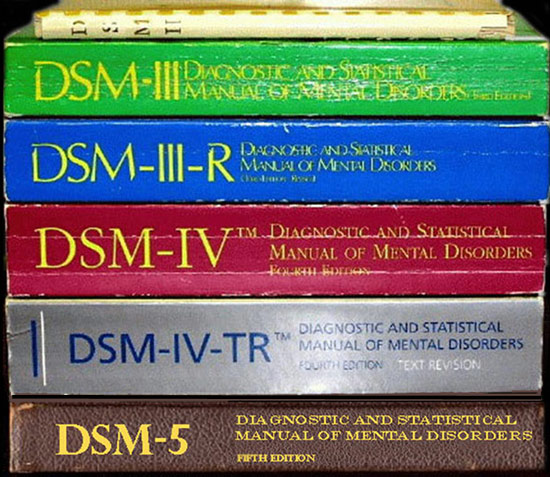
Η British Psychology Society με ανακοίνωση της κατακεραυνώνει το Diagnostic and Statistical Manual of Mental Disorders, το οποίο ετοιμάζει την πέμπτη έκδοση του τον Μάιο 2013 (DSM-V).
Οι δήθεν διαγνώσεις που παρουσιάζονται στο DSM-V βασίζονται σε μεγάλο βαθμό σε κοινωνικούς κανόνες, με «συμπτώματα» που βασίζονται σε υποκειμενικές κρίσεις, με λίγα επιβεβαιωτικά φυσικά σημάδια ή αποδεικτικά στοιχεία των βιολογικών αιτιών.
BPS concerns about overmedicalisation
The British Psychological has expressed strong reservations about the approach taken by the fifth edition of the American Psychiatric Association’s Diagnostic and Statistical Manual of Mental Disorders (DSM-V), which will be published in May 2013. The manual is widely used in Britain to diagnose and classify people suffering from mental health problems.
The Society is concerned that clients and the general public are negatively affected by the continued and continuous medicalisation of their natural and normal responses to their experiences. These responses which undoubtedly have distressing consequences that demand helping responses, but do not reflect illnesses so much as normal individual variation.
Professor Peter Kinderman from the University of Liverpool, the lead author of the Society’s response to the draft manual released for consultation said:
The putative diagnoses presented in DSM-V are clearly based largely on social norms, with ‘symptoms’ that all rely on subjective judgements, with few confirmatory physical signs or evidence of biological causation. We have particular concerns over the draft’s consideration of the inclusion of a range of highly contentious ‘disorders’. These include Attenuated Psychosis Syndrome, which could be seen as an opportunity to stigmatise eccentric people, and to lower the threshold for achieving a diagnosis of psychosis, Gender Dysphoria (especially in children and adolescents) and a range of conduct disorders such as Oppositional Defiant Disorder – diagnosed when a child is ‘headstrong’ or ‘wilful’.
The Society is concerned that such diagnostic systems fall short of the criteria for legitimate medical diagnoses. It recommends a revision of the way mental distress is thought about, starting with recognition of the overwhelming evidence that mental ill-health is on a spectrum with ‘normal’ experience, and that psychosocial factors such as poverty, unemployment and trauma are important causal factors.
The Society believes that alternatives to diagnostic frameworks such as case formulations (whether from a single theoretical perspective or more integrative) exist, should be preferred and should be developed with as much investment of resource and effort as has been expended on revising DSM-IV.
The full text of the response is available on the Society’s website.
υ.γ. μια προσεκτική ανάγνωση του αρχείου ανέδειξε και τα εξής ενδιαφέροντα στη σελίδα 22:
Code: Q00-07 / Disruptive, Impulse Control and Conduct Disorders
As stated in our general comments, we are concerned that clients and the general public are negatively affected by the continued and continuous medicalisation of their natural and normal responses to their experiences; responses which undoubtedly have distressing consequences which demand helping responses, but which do not reflect illnesses so much as normal individual variation.
We believe that classifying these problems as ‘illnesses’ misses the relational context of problems and the undeniable social causation of many such problems. For psychologists, our well-being and mental health stem from our frameworks of understanding of the world, frameworks which are themselves the product of the experiences and learning through our lives.
All the comments made earlier apply also here. Of particular concern are the subjective and socially normative aspects of conformist behaviour. We are very concerned that ‘headstrong’ behaviour is considered to be pathognomic of an illness (in Oppositional Defiant Disorder). Many people – many governments – would like children and citizens to be less defiant and more compliant. However, it is not a symptom of illness to be defiant. It may be a social or psychological problem to be addressed, but it may, in some circumstances, be a characteristic to be praised.
An ‘unspecified’ disruptive or impulse control disorder, in this context, is even more subjective, value-laden, conceptually confused, and therefore worrying.